
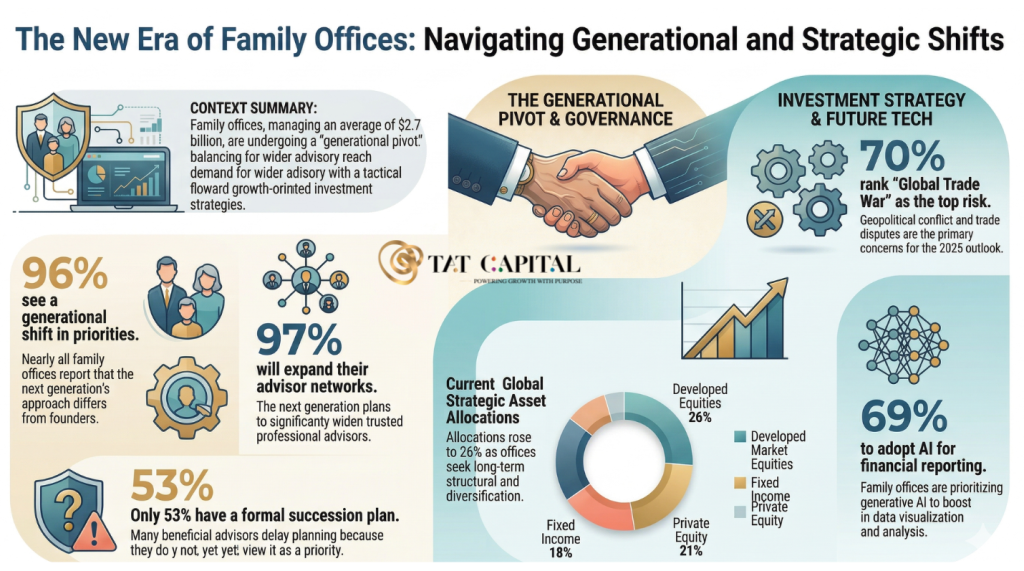
From Founder-Led to Institution-Led
The first generation of wealth creators typically operated with speed, intuition, and concentration of control. Decision-making was centralized, often informal, and driven by entrepreneurial instinct rather than structured frameworks.
The next generation, however, is transitioning family offices into enduring institutions designed to outlive individuals.
This shift is manifesting in several ways:
- Formal Governance Structures: Investment committees, family councils, and independent boards are becoming standard. Decision-making is being codified, reducing key-person risk and ensuring continuity across generations.
- Professional Management Talent: Families are increasingly bringing in external CIOs, risk officers, and domain specialists—blurring the line between a private office and an institutional asset manager.
- Clear Separation of Roles: Ownership, management, and family interests are being disentangled. This reduces conflict and allows for more objective, performance-driven outcomes.
Yet, despite this progress, succession planning remains emotionally complex.
The most successful families are proactively:
- Creating structured transition roadmaps (not event-driven handovers)
- Encouraging open dialogue around wealth, responsibility, and legacy
- Investing in next-gen readiness, not just inheritance
The insight here is simple but powerful:
Wealth rarely fails in markets—it fails in transitions.
1. The Rise of the Digitally Native Capital Allocator
Next-generation principals are the first cohort to grow up fully immersed in data, platforms, and digital ecosystems. As a result, their expectations from a family office are fundamentally different.
They are not satisfied with periodic reports—they want:
- Real-time portfolio visibility
- Interactive dashboards
- Scenario-based decision tools
This is driving a full-stack technology transformation:
- Integrated Wealth Platforms: Consolidating multi-asset, multi-jurisdiction portfolios into a single, unified interface.
- Automation of Middle and Back Office: Tasks like reporting, compliance, and reconciliation are increasingly automated—freeing up human capital for higher-value strategic thinking.
- AI as a Decision Layer (not just a tool): AI is being used to: Identify patterns across large datasets Stress-test portfolios under different macro scenarios Summarize complex legal and financial documentation instantly
More importantly, AI is democratizing insight.
Younger principals are increasingly comfortable using tools like generative AI to challenge assumptions, validate strategies, and independently form views—reducing blind reliance on advisors.
2. Advisory Relationships Are Being Rewritten
Historically, advisory relationships in family offices were long-standing, relationship-driven, and often inherited.
That model is being disrupted.
The next generation is unbundling advice and curating a modular ecosystem of specialists, rather than relying on a single trusted firm.
Key shifts include:
- From Loyalty to Meritocracy: Advisors are no longer retained by default. Performance, insight quality, and responsiveness are continuously evaluated.
- Demand for Radical Transparency: Fee structures, investment performance, and underlying decision logic are expected to be fully visible and easily interpretable.
- Collaborative Engagement Models: Instead of passive reporting, next-gen principals expect to co-create strategies—engaging in active dialogue rather than receiving static recommendations.
- Global and Thematic Expertise: Advisors are increasingly selected based on their ability to provide access to: Alternative investments Cross-border opportunities Emerging sectors like AI, climate tech, and digital assets
This creates a new bar for advisors:
It’s no longer enough to “manage wealth”—you must augment decision-making.
3. A New Investment Playbook Emerges
The portfolio construction philosophy of family offices is undergoing a multi-dimensional shift, balancing preservation with participation in future growth.
a. Stability Meets Sophistication
In an environment defined by inflation, rate volatility, and uncertainty, family offices are prioritizing predictability of income.
- Private Credit & Direct Lending: Attractive for their yield premium, downside protection, and asset-backed nature.
- Real Estate Repositioning: Moving beyond trophy assets toward: Income-generating properties Sectoral diversification (logistics, data centers, living sectors) Geographic risk balancing
The emphasis is shifting from “what can appreciate?” to “what can endure?”
b. Conviction in Structural Growth
Despite macro volatility, family offices are not retreating—they are leaning into long-term megatrends.
- Equities as Growth Engines: Increased allocation to developed markets to capture innovation cycles.
- Thematic Investing: Focus areas include: Artificial Intelligence Biotechnology and healthcare innovation Energy transition and electrification
This reflects a mindset shift:
Volatility is tolerated if the underlying trend is irreversible.
c. Impact Is Now Core Strategy
Perhaps the most defining shift is the integration of values into capital allocation.
For the next generation:
- Wealth is not just a store of value
- It is a tool for influence and responsibility
This is leading to:
- ESG considerations embedded into core portfolios (not side allocations)
- Increased allocation to climate tech, clean energy, and social infrastructure
- A preference for investments with measurable outcomes, not just financial returns
In many cases, impact and alpha are no longer seen as trade-offs—but as aligned objectives.
4. The Silent Driver: Fear
While strategy appears forward-looking, it is deeply shaped by underlying macro anxieties.
Family offices today are navigating a world where:
- Traditional asset correlations are breaking down
- Geopolitical tensions are persistent, not episodic
- Inflation and interest rates remain structurally uncertain
These concerns are driving defensive sophistication:
- Diversification Beyond the Traditional 60/40
- Increased Use of Hedge Funds for Uncorrelated Returns
- Allocations to Gold and Real Assets as Crisis Hedges
- Active Management to Navigate Dispersion
In essence: The modern portfolio is being built not just for growth—but for resilience under stress.
Strategic Philanthropy: From Charity to Change
Philanthropy is undergoing a transformation from emotional giving to engineered impact.
Next-gen principals are approaching it with the same rigor as investing:
- Long-Term Capital Commitment: Multi-year funding strategies rather than ad-hoc donations.
- Systems-Level Thinking: Addressing root causes (education, healthcare access, climate) rather than symptoms.
- Measurement and Accountability: Defining success through outcomes, not intent.
- Direct Engagement: Many are moving beyond donations to: Building their own foundations Partnering deeply with domain experts Applying venture-style thinking to social challenges
This reflects a broader identity shift: From wealth owners → to capital stewards with purpose.