
Supply Chain Finance: The Quiet Engine Unlocking Working Capital in Global Value Chains
In today’s environment of tighter liquidity, higher interest rates, and increasingly complex global supply chains, working capital management has become a strategic priority rather than a back-office function.
One of the most powerful — yet often underappreciated — tools enabling this shift is Supply Chain Finance (SCF).
Once considered a niche treasury solution, SCF is now emerging as critical financial infrastructure that supports the flow of trade across global value chains.
Financing Real Economic Activity
What differentiates Supply Chain Finance from traditional lending is its foundation: verified trade transactions.
Unlike unsecured corporate credit, SCF financing is typically:
• Linked to approved invoices for goods already delivered • Supported by contractual payment obligations • Anchored to the credit profile of the buyer rather than the supplier • Structured as short-duration, self-liquidating exposures
Because financing is tied to actual commercial transactions rather than general balance-sheet lending, risk levels historically tend to be significantly lower than unsecured corporate credit.
This structure enables capital providers to finance working capital while maintaining disciplined risk exposure.
A Win for Suppliers, Buyers, and Capital Providers
Supply Chain Finance works because it creates value across the entire ecosystem.
Suppliers
SCF allows suppliers to convert receivables into cash quickly, improving liquidity and reducing dependence on expensive unsecured borrowing.
Buyers
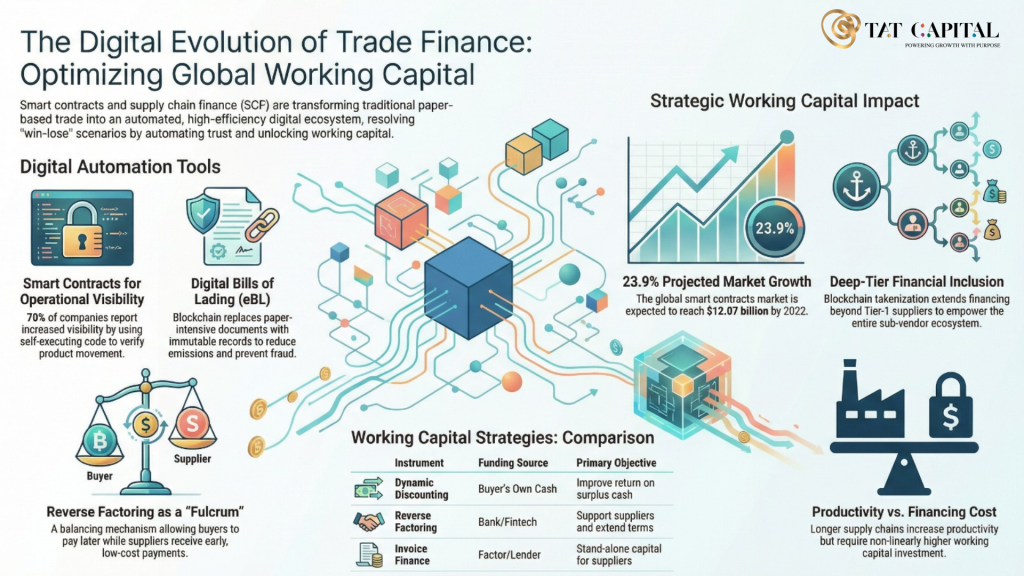
Large corporates can optimise their working capital by extending payment terms while still ensuring suppliers receive early payment if needed.
Capital Providers
For financiers and institutional investors, trade-linked assets offer short-tenor exposures backed by real economic activity, often with strong buyer credit profiles.
This alignment creates a rare win-win structure across the supply chain.
Technology Is Transforming SCF
The rapid growth of Supply Chain Finance would not be possible without digital platforms.
Modern SCF ecosystems rely on technology that enables:
• Real-time invoice verification • Automated transaction workflows • Transparent reporting across participants • Scalable onboarding of suppliers and buyers
Increasingly, AI and advanced data analytics are being deployed to improve risk assessment, automate credit decisions, and predict liquidity needs across supply chains.
What was once manual and fragmented is becoming a fully integrated financial ecosystem.
Global Liquidity Cycles Matter
Supply Chain Finance also sits within the broader context of global monetary and currency dynamics.
A strengthening U.S. dollar or tightening global liquidity conditions can significantly impact the availability of trade credit.
Because much of global trade is dollar-denominated, changes in U.S. monetary policy often ripple through supply chains worldwide — affecting banks’ lending capacity and the availability of working capital financing.
For exporters and globally integrated firms, understanding these liquidity cycles is becoming increasingly important.
The Next Frontier: Deep-Tier Supply Chain Finance
While most SCF programs focus on Tier-1 suppliers, the greatest untapped opportunity lies deeper in supply chains.
Extending financing to Tier-2 and Tier-3 suppliers could unlock significant liquidity across global manufacturing ecosystems.
However, scaling deep-tier finance requires overcoming several challenges:
• Fragmented legal frameworks across jurisdictions • Difficulty verifying obligations across multiple supplier layers • Complex regulatory and compliance requirements
Solving these issues will require better data infrastructure, stronger digital platforms, and more coordinated regulatory frameworks.
Working Capital as Strategic Infrastructure
As supply chains become more interconnected and capital markets more volatile, the role of Supply Chain Finance will continue to expand.
What was once a treasury optimisation tool is increasingly becoming core financial infrastructure supporting global trade.
Companies that understand and integrate these mechanisms into their operating models will be better positioned to manage liquidity, strengthen supplier ecosystems, and navigate increasingly complex global markets.