

Strategic Implications for Clients with Open Foreign Exchange Invoices
Escalating military activity involving Iran and reported disruption risks around the Strait of Hormuz have triggered a rapid repricing across energy and foreign exchange markets.
Brent crude has moved sharply higher as traders price supply disruption risk. Concurrently, safe-haven assets — notably USD and JPY — have strengthened, while growth-sensitive currencies, including AUD, have come under pressure.
For clients with open FX invoices, this is not a single-currency event. The shock transmits across the AUD complex:
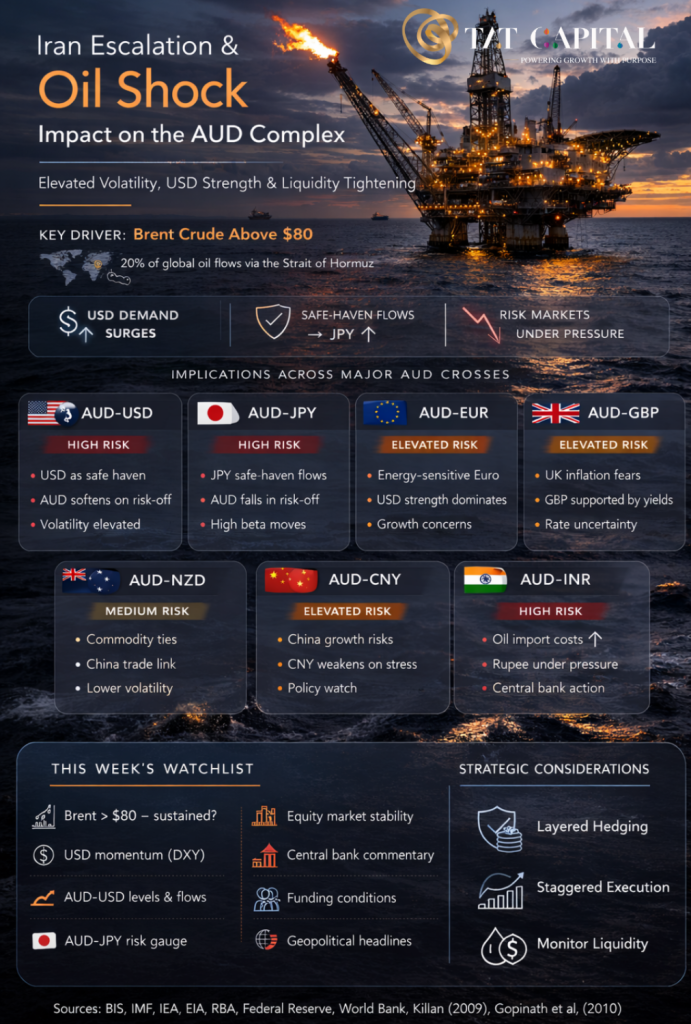
AUD-USD | AUD-EUR | AUD-GBP | AUD-JPY | AUD-NZD | AUD-CNY | AUD-INR
The principal risk in this environment is not direction alone, but volatility persistence, liquidity tightening, and execution timing.
The Transmission Mechanism
a. Energy Channel
Approximately 20% of global crude exports transit the Strait of Hormuz. Even temporary disruption introduces a geopolitical premium into oil markets.
Transmission effects typically include:
- Higher oil prices
- Increased freight and war-risk insurance costs
- Rising USD settlement demand
- Widening trade deficits for oil-importing economies
- Elevated inflation expectations
When oil rises due to supply disruption, the effect acts as a tax on global growth rather than a signal of demand strength.
This distinction is critical for FX markets.
b. Risk Sentiment & USD Liquidity
Geopolitical escalation historically drives:
- Safe-haven demand for USD and JPY
- De-risking of high-beta currencies
- Equity repricing
- Short-term funding tightness
The Australian dollar — historically correlated with global growth expectations and investor risk appetite — has often underperformed during acute risk-off episodes, particularly when USD funding conditions tighten.
A pro-cyclical currency typically strengthens when global growth and risk appetite are strong, and weakens during periods of economic stress.
Importantly, AUD performance during oil rallies depends on the driver:
- Demand-driven oil strength (global expansion) can support AUD.
- Supply-driven oil spikes accompanied by risk aversion have more frequently coincided with AUD underperformance (e.g., 1990, 2008, 2020).
This is a probabilistic historical pattern — not a mechanical rule.
Historical Context: Oil Shock Market Phases
Across prior geopolitical oil disruptions (1973, 1990, 2008, 2020), markets have often followed a three-stage structure:
Phase 1 – Volatility Spike
- Oil rallies
- USD and JPY strengthen
- Pro-cyclical currencies weaken
- Bid-ask spreads widen
Phase 2 – External Balance Pressure
- Oil importers widen current account deficits
- Sovereign yields rise
- Hedging demand increases
Phase 3 – Funding & Trade Tightening
- Settlement cycles extend
- Funding costs increase
- Liquidity compresses near month-end
- Working capital strains intensify
Current conditions are consistent with early-stage volatility dynamics. Persistence will depend on duration and escalation.
Implications Across Major AUD Crosses
AUD-USD
USD has historically strengthened during geopolitical stress given its funding-currency role. AUD has often underperformed in sustained risk-off conditions, though relative rate policy and China dynamics remain important offsets.
AUD-JPY
A high-beta risk proxy. Historically exhibits amplified moves during stress episodes due to AUD growth sensitivity and JPY safe-haven demand.
AUD-EUR
EUR is energy-sensitive. Relative growth expectations and ECB posture will determine direction. USD dominance in global flows may influence indirect pricing.
AUD-GBP
GBP performance will reflect relative inflation expectations and rate differentials. Oil-driven UK inflation may support GBP on yield grounds, partially offsetting risk flows.
AUD-NZD
Typically less volatile due to structural similarity. Divergence would likely stem from relative terms-of-trade shifts or central bank guidance.
AUD-CNY
Highly sensitive to Chinese policy response. If oil dampens global trade expectations, CNY softness could offset broader AUD risk pressure.
AUD-INR
Directly exposed to oil dynamics. India imports ~85% of crude requirements. Sustained Brent strength increases USD demand and raises RBI intervention probability. Direction may reflect a relative contest between global risk sentiment and oil import exposure.
Cross-Border Payment & Trade Finance Considerations
Clients with open invoices should anticipate:
- Elevated USD funding demand
- Wider bid-ask spreads (particularly Asia hours)
- Liquidity compression near month-end
- Increased forward hedging flows
- Potential repricing of energy-linked shipments
Execution timing becomes materially more important during volatility clustering.
What Determines the Next Move?
Key variables:
- Duration of Hormuz disruption
- Escalation into formal sanctions
- Brent sustaining above $80
- Central bank policy responses
- Stability in global equities
Rapid de-escalation would likely compress volatility. Prolonged disruption would increase funding stress and FX dispersion.
Final Assessment
This is not solely an oil story. It is a multi-layer transmission event affecting:
- Energy pricing
- Capital flows
- Fiscal balances
- Trade finance dynamics
- Global FX liquidity
For clients exposed across AUD crosses, the central risk is volatility persistence rather than directional certainty.
Historical precedent suggests that supply-driven oil shocks accompanied by risk aversion have often pressured pro-cyclical currencies such as AUD. However, outcomes remain conditional on USD liquidity dynamics, policy responses, and the duration of disruption.
In this environment, disciplined execution, staggered hedging, and forward planning are likely to deliver more resilient outcomes than reactive conversion during peak stress windows.