
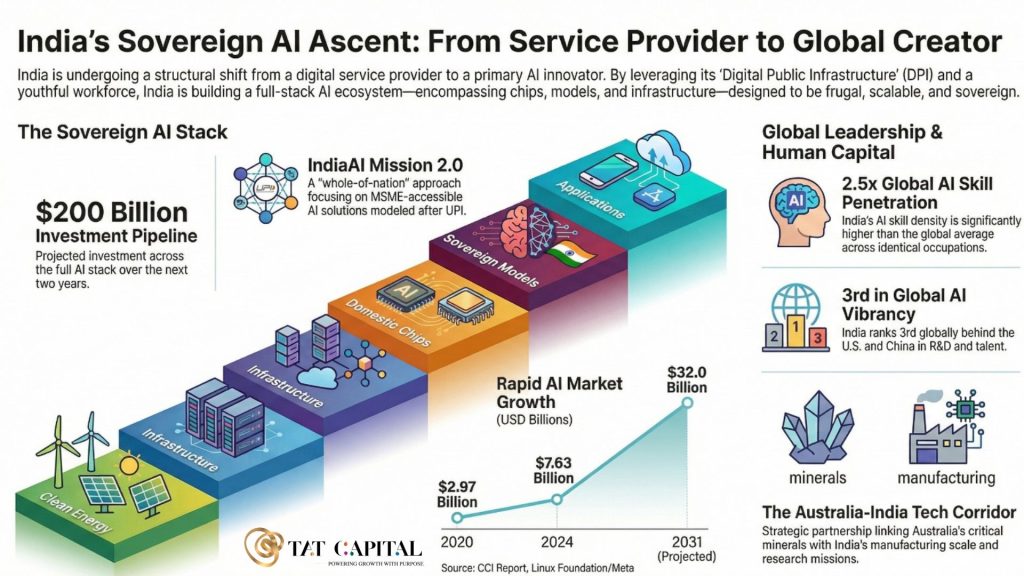
Artificial intelligence is no longer just a race for scale. It’s becoming a race for relevance.
While the United States and China compete to build ever-larger foundation models, India is quietly shaping a different path — one grounded in frugality, public infrastructure, and inclusion. And in doing so, it may be defining the next chapter of AI for the Global South.
Here’s why that matters — not just for India, but for Australia and the broader Indo-Pacific
1️⃣ From Scale Obsession to “Right-Sized” Intelligence
India’s AI strategy diverges sharply from the compute-heavy model of Silicon Valley and Beijing.
Rather than pursuing massive horizontal LLMs at any cost, India emphasizes:
- Model distillation and pruning
- Smaller, fit-for-purpose architectures
- Reduced cloud dependency
- Lower energy consumption
This “right-sizing” approach maximizes impact per unit of complexity — making AI deployable in low-connectivity, cost-sensitive environments.
It’s not about minimizing ambition. It’s about optimizing efficiency.
2️⃣ Vertical AI Over Horizontal Dominance
Instead of trying to outbuild GPT-style systems, Indian startups are doubling down on Vertical AI — domain-focused intelligence for:
- Agriculture
- Rural healthcare
- Financial inclusion
- Public service delivery
This strategy creates defensible expertise in high-impact sectors rather than competing head-on with hyperscalers.
In emerging markets, vertical depth often beats horizontal scale.
3️⃣ Digital Public Infrastructure as an AI Multiplier
India’s greatest competitive advantage isn’t just talent — it’s infrastructure.
Platforms like:
- Aadhaar
- Unified Payments Interface (UPI)
- DigiLocker have created a population-scale digital backbone.
This Digital Public Infrastructure (DPI):
- Provides interoperable, secure data layers
- Enables rapid AI integration without rebuilding systems
- Allows deployment at national scale through public-private partnerships
Few countries possess this kind of open, API-driven digital architecture.
India isn’t just building AI models — it’s embedding AI into society.
4️⃣ Open-Source as a Strategic Lever
Nearly 70% of Indian AI startups rely on open-source frameworks.
This:
- Lowers entry barriers
- Reduces dependency on proprietary systems
- Accelerates local language customization
- Encourages decentralized innovation
In contrast to walled-garden ecosystems, India’s approach democratizes participation in AI development.
The result? Broader diffusion, not just concentrated power.
5️⃣ Governance with a Whole-of-Government Approach
Responsible AI is not an afterthought.
Through the India AI Governance Guidelines and the IndiaAI Mission, the government is pursuing:
- Ethical deployment standards
- Indigenous model development
- Affordable computing access
- Sector-wide AI integration
This “whole-of-government” model aims to align innovation, regulation, and deployment — an increasingly rare balance in global tech policy.
Australia India The Strategic Technology Partnership
India’s AI evolution intersects directly with Australia’s technology strategy.
Through initiatives like:
- Australia-India Strategic Research Fund
- Australia-India Cyber and Critical Technology Partnership
- ACITI Partnership
The two nations are advancing collaboration in:
- Critical minerals supply chains
- Clean energy manufacturing
- AI governance alignment
- Frontier research (quantum, biotech, climate tech)
- Space cooperation and Earth observation
For Australia, India represents scale and software capability. For India, Australia offers critical minerals, research strength, and geopolitical alignment.
This is no longer a transactional relationship — it’s a mission-oriented partnership shaping Indo-Pacific resilience.
The Bigger Question
What if the future of AI isn’t defined by who builds the biggest model…
…but by who integrates intelligence most effectively into society?
India’s frugal AI model suggests that:
- Accessibility can beat exclusivity
- Infrastructure can beat brute-force compute
- Vertical specialization can beat horizontal dominance
- Inclusion can be a growth strategy
If successful, this approach could become the blueprint for emerging economies worldwide. And that would fundamentally reshape the global technology hierarchy.
Final Thought
The AI race is not just about algorithms. It’s about architecture — digital, economic, and geopolitical.
India is building all three at once.
The real question is: Are global partners ready to engage with this new model of innovation?