
very year, more families cross a threshold they didn’t plan for: a business sale, an IPO, an inheritance — and suddenly they’re managing more liquid wealth than any single bank relationship or spreadsheet can handle.
This is the moment the family office was invented for.
Here’s the short version of what it is, why it exists, and how to choose the right one.
It started with a butler
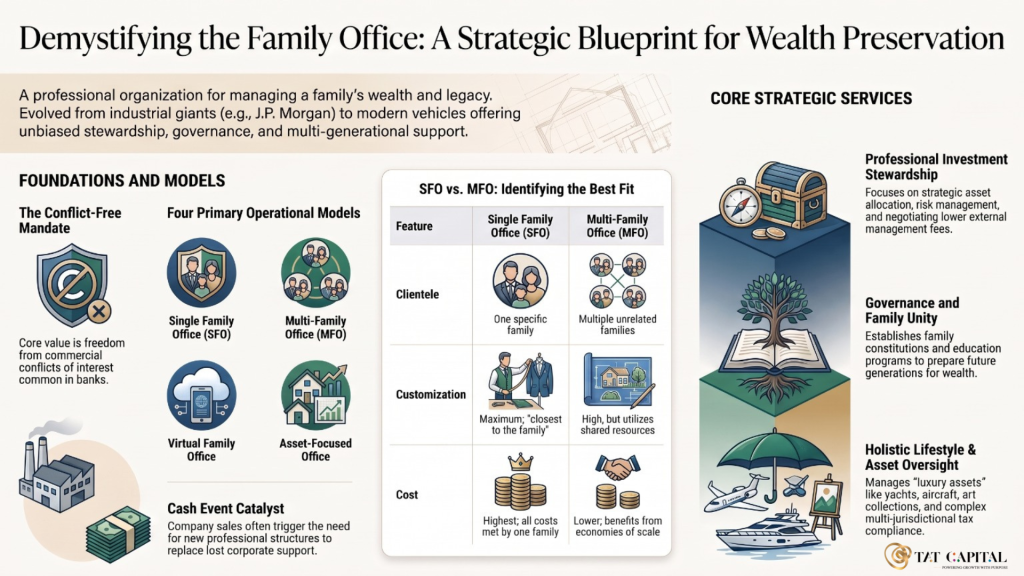
The family office isn’t a modern invention — it’s a very old idea in a new suit. Its roots go back to the majordomo, the highest-ranking servant in a European noble household, trusted to run the family’s domestic and financial affairs.
The modern version dates to 1838, when the House of Morgan began managing the Morgan family’s wealth — later extending to the Vanderbilts, Guggenheims, and DuPonts. The Rockefellers followed in 1882. But the real explosion came in the 1980s, when a wave of newly wealthy families got fed up with commission-hungry banks and started demanding a “competent deputy” who worked for them, not the bank.
Today there are more than 8,000 single-family offices worldwide, managing over $3 trillion, with total family wealth in these structures projected to hit $9.5 trillion by 2030.
The moment that triggers it: the “Cash Event”
Most families don’t build a family office proactively — they build one reactively, after a “Cash Event” (usually selling the operating business).
That single event quietly wrecks three things at once:
● Structure — liquid assets replace an operating business, but nobody’s managing them full-time
● Support — the internal finance team and admin staff disappear with the company
● Identity — the family’s sense of purpose was tied to the business; without it, there’s a void
The family office fills that void. It becomes the new family firm — a fresh, shared mission built around stewardship instead of operations.
Why not just use a bank?
Because a bank has a built-in conflict of interest: it profits from selling you things. A family office doesn’t. Its entire reason for existing is independence — no commissions, no proprietary products, no incentive except your outcome.
Independent cost audits of private banking relationships have repeatedly found that real, all-in fees run well above the advertised rate once hidden and layered costs are counted — exactly the blind spot a family office is built to close.
he two jobs it actually does
“Hard” services — the financial shield
Asset allocation and direct deals, consolidated multi-asset reporting, tax and legal compliance across jurisdictions, and independent audits that catch hidden fees and manager misconduct.
“Soft” services — the human shield
Family governance (a charter or constitution), succession planning, next-gen education — both technical (IQ) and emotional (EQ) — and philanthropy, increasingly shaped by ESG priorities from younger generations.
Family infighting destroys more fortunes than bad markets ever will. The “soft” side isn’t optional — it’s risk management.
Choosing a structure
There’s no universal answer — it depends on assets, complexity, and how much control you want:
Model – Best for
- SFO (Single Family Office) – Maximum privacy and customization — at the highest cost
- MFO (Multi-Family Office) – Shared cost and scale across several families
- VFO (Virtual Family Office) – Multi-jurisdiction families who want flexibility without a physical office
- AMFO (Asset Manager Family Office) – Families whose priority is direct deals and investment “firepower”
The bottom line
A family office is a “competent deputy” — a structure that turns a pile of assets into a lasting legacy, and turns a liquidity event from an identity crisis into a new shared mission.
The families that get this right start early, govern deliberately, and treat the “soft” side with the same rigor as the balance sheet.