
If you’re still running your trade strategy on a “business-as-usual” playbook, it’s time for an update.
We’ve entered a genuinely new era of global trade — one where tariffs are being used as instruments of statecraft, average U.S. tariff rates have climbed to levels not seen since the 1930s (~18%), and the old rules of market access are being replaced by a new game: rule-making. Digital data, carbon costs, and security risk are now as central to trade strategy as the price of freight.
Here’s what’s actually happening, and why it matters for Australian businesses.
1. The tariff shock is real — but Australia may be a net winner.
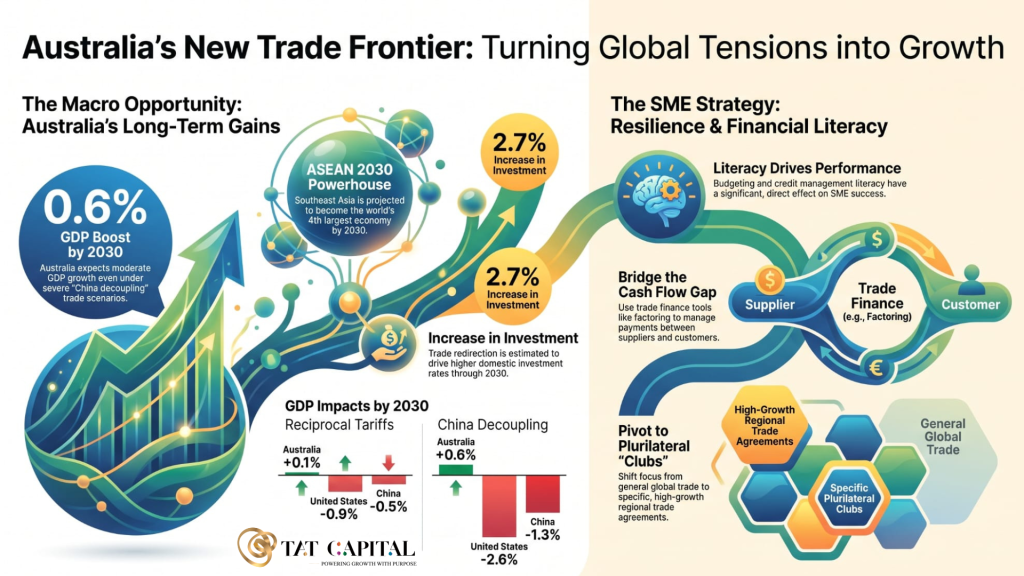
EY’s EYGEM modelling shows a striking divergence: under a full U.S.–China decoupling scenario, the U.S. economy takes the biggest hit (-2.6% GDP), China is moderately impacted (-1.3%), and Australia is projected to see a moderate long-term benefit (+0.6%). Why? As trade redirects away from both giants, Australia captures lost market share, imports get cheaper, and our terms of trade improve. We’re becoming a “stable haven” for capital — investment here is projected to rise even as U.S. investment falls.
2. Five structural shifts are rewriting the rules.
Geopolitics, digital transformation, carbon pricing, plurilateral trade clubs (think RCEP, AANZFTA), and supply chain resilience are no longer background trends — they’re the operating environment. Businesses that diversify their trade relationships and invest in “digital-proofing” their logistics will be the ones capturing the upside.
3. The opportunities are sector-specific.
Australian beef and energy producers are stepping into gaps left by U.S. exporters facing Chinese retaliatory tariffs. Critical minerals are attracting U.S. capital locked out of China. Meanwhile, pharma exporters need to watch the 100% U.S. tariff closely, and the AUD’s likely appreciation (as U.S. rates fall below ours) is a currency risk worth planning for now, not later.
4. The real bottleneck isn’t opportunity — it’s liquidity.
This is the part that gets missed in the macro headlines. None of these openings matter if a business can’t bridge the cash-flow gap created by longer shipping routes and payment delays. This is exactly where trade finance — factoring, letters of credit, invoice finance, supply chain finance — earns its place as a genuine risk-transfer tool, not just a liquidity top-up. Research consistently shows the most commonly neglected skill among SMEs isn’t finding capital — it’s calculating whether they can actually sustain the cost of it.
5. ASEAN is the growth frontier through 2030.
Growing at ~4.9% real GDP and on track to be the world’s 4th-largest economy, the region offers concrete openings: agribusiness and clean energy in the Philippines, aerospace and Smart Nation ICT in Singapore, power infrastructure in Vietnam. Plurilateral access via RCEP and AANZFTA makes entry meaningfully easier than it was a decade ago.
The bottom line: volatility isn’t going away, but it isn’t purely a threat either. The businesses and investors who treat this as a genuine strategic inflection point — diversifying relationships, getting serious about trade finance discipline, and positioning early in ASEAN and critical minerals — will be the ones leading the next decade of trade, not just surviving it.
This is precisely the intersection where we spend our time at Tat Capital — helping businesses navigate the Australia–India corridor and the broader Indo-Pacific shift with the right mix of FX strategy, trade finance structuring, and corporate advisory.