
Why Profitable Exporters Still Run Out of Cash
The “Cash-Flow Timing Game” every exporter is playing — and how the smart ones win it.
Here’s a scenario I see play out constantly in trade finance: a business lands the order of their year. Great margin, great buyer, great product-market fit. Eighteen months later, they’re in trouble — not because the deal was bad, but because the timing was.
That’s the paradox at the heart of export finance: profit on paper doesn’t pay salaries. Cash does.
An exporter has to spend real money today — on raw materials, labor, freight — for a buyer who might not pay for months. And here’s the part that catches people off guard: growth makes this worse, not better. More orders means more capital locked in transit at any given moment. The better the year looks on paper, the tighter cash can get in practice.
The three-stage squeeze
Every export deal moves through the same cash-draining sequence:
- Production (15–90 days): cash goes out for materials, labor, utilities
- Shipping (7–30 days): cash goes out for freight and port charges — and you’ve lost physical control of the goods
- Payment wait (30–180 days): goods have landed, but you’re on the buyer’s clock now
That’s up to six months between spending the money and getting it back. Multiply that across a growing order book, and you can see exactly how a profitable company runs out of liquidity.
The fix isn’t one loan — it’s two, working in relay
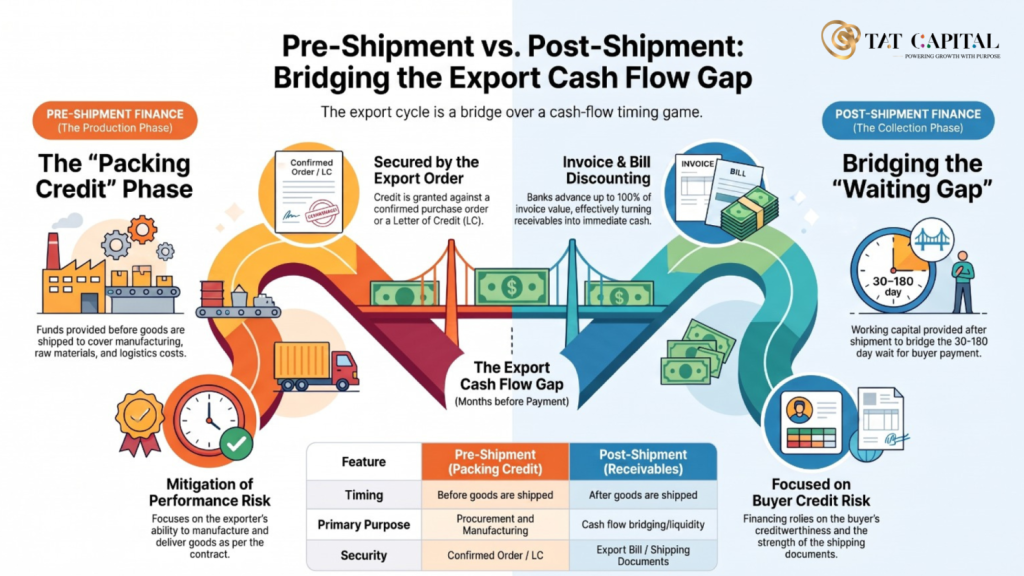
The best-run exporters don’t treat this as a single financing problem. They use a two-stage credit framework that hands off from one facility to the next, in sync with the deal itself:
Stage 1 — Pre-Shipment Finance (“Packing Credit”) Funds production before the goods ship — raw materials, labor, packing. Secured by the stock itself. The smart move here: borrowing in the buyer’s currency (PCFC) rather than local currency. It’s usually cheaper and it closes your FX exposure automatically — no separate hedge required.
Stage 2 — Post-Shipment Finance The moment the Bill of Lading is issued, the game changes. The goods are gone, performance risk disappears, and the only question left is: will the buyer pay? This is where the toolkit gets interesting:
If you need – Reach for
- Fast cash on a one-off shipment – Bill Discounting
- A reliable buyer, but want collections handled for you- Export Factoring
- Security against a high-risk country – LC Discounting
- Non-recourse financing for a multi-year capital goods deal – Forfaiting
The magic is in the handoff: the same pre-shipment debt converts directly into a post-shipment facility the second the shipping documents land on the banker’s desk. Nothing sits idle. Nothing needs to be re-negotiated from scratch.
A $100K order, start to finish
An Indian textile exporter takes a $100,000 order from a European buyer. They don’t have the $60,000 needed for cotton and labor — so they draw it as Packing Credit. They manufacture, they ship, they get the Bill of Lading. That $60,000 pre-shipment debt then converts into a post-shipment Bill Discounting facility, and the bank releases the remaining $40,000. Sixty days later, the buyer pays the bank directly — loan liquidated, deal closed.
The real win: because the facility is self-liquidating, that exporter can start their next order immediately, while this one is still at sea.
The one line worth remembering
Export finance isn’t extra cash. It’s the tool that turns a paper profit into money you can actually spend.
Get the sequencing right — pre-shipment funding, converting cleanly into the right post-shipment instrument, backed by credit insurance and accurate documentation — and even a small exporter can compete on payment terms with players many times their size.