
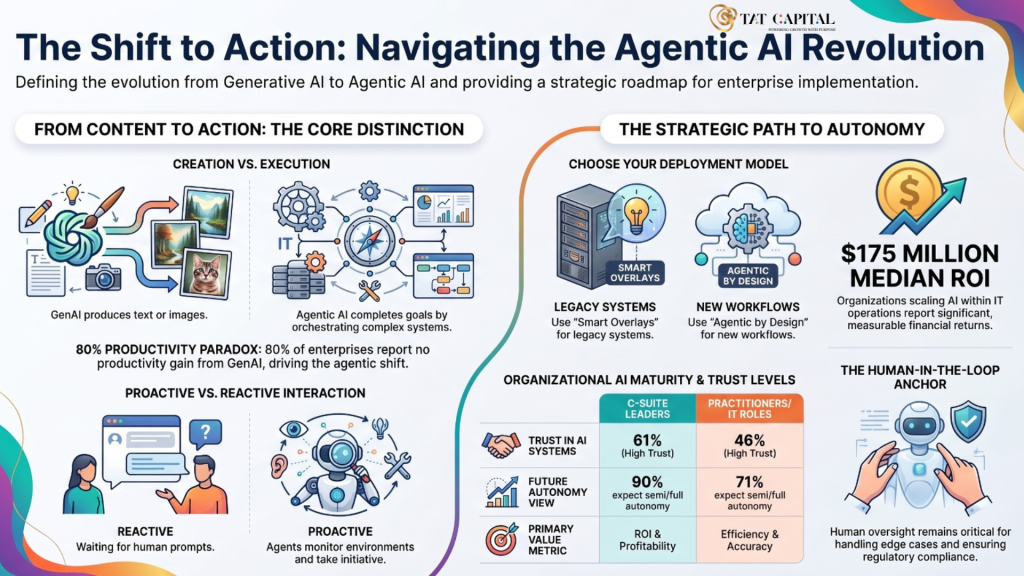
Here’s a number that should worry every executive who signed off on a generative AI budget this year: 78% of enterprises have adopted GenAI. 80% say it hasn’t moved the needle on productivity, cost, or revenue.
We’ve been calling this the “GenAI Paradox.” I’d call it something simpler: we bought a brilliant writer and expected a doer.
Generative AI is, at its core, a reactive tool. It drafts the email. It summarizes the report. It writes the code. But it waits — always — for someone to ask. It refines how a task gets done. It never decides what should happen next. And in an enterprise, “what happens next” is where the value actually lives.
That’s the gap Agentic AI is built to close.
From Assisting to Performing
Where Generative AI lowered the cost of creation, Agentic AI lowers the cost of action. The difference isn’t semantic — it’s architectural. An agentic system perceives its environment (a liquidity fluctuation, a payment failure, an inventory shortfall), plans a response, and acts on it across connected systems, adjusting course the way a GPS recalculates around traffic. No prompt required.
This is powered by a simple but powerful loop: Perceive → Plan → Act. The agent gathers data, breaks a goal into sub-tasks, executes across the enterprise stack, and monitors the outcome — continuously, autonomously, and (critically) traceably.
And the economics are already showing up. Digitate’s 2025 research puts the median ROI of agentic implementations at $175 million, with realized returns averaging $221 million against roughly $187 million in implementation spend. By 2030, an estimated 74% of leading organizations expect to operate at least semi-autonomously.
You Don’t Need to Rip and Replace
The most common objection I hear is some version of: “Our core systems are twenty years old. We can’t just bolt agents onto that.”
You don’t have to. There are three well-worn pathways in:
- Smart Overlay — wrap an agent around your existing systems, using your documented SOPs as its script. Fast to deploy, low risk, and it works even with legacy or COBOL-based cores. Think: a routine cash sweep becoming a dynamic liquidity optimizer, or a 3-day address-change process collapsing to near-instant.
- Agentic by Design — build new, specialized micro-agents as part of a modern microservices architecture, coexisting with legacy systems via an “AI Fabric.” Higher investment, but far higher ceiling.
- Process Redesign — the most transformational path, where AI is embedded at every decision point and workflows are rebuilt from first principles rather than automated step by step.
JD.com‘s SCPA framework is a useful proof point of what the top of that curve looks like: a 40% reduction in weekly data processing time, a 22% increase in plans holding under 5% deviation, and a 2–3% increase in fulfilment rates.
The Part Everyone Skips: Governance
Here’s what doesn’t get said enough in the agentic AI hype cycle: autonomy is a risk category, not just a capability.
The moment an agent can independently touch an API or a core ledger, you’ve moved from “hallucination risk” to “unintended autonomous action” risk — infinite feedback loops, API misuse, data poisoning. That demands real infrastructure, not good intentions:
- An Agent Registry — owner, scope, permitted API endpoints, and financial exposure limits for every agent in production.
- Digital wallets — hard, programmatic caps on what an agent can spend or execute, so a compromised agent can’t run away with your balance sheet.
- Tiered human-in-the-loop checkpoints — full autonomy for low-risk, routine work; mandatory human validation for anything high-stakes, like credit approvals or regulatory filings.
There’s a trust gap worth naming here too: 61% of C-suite leaders say they trust AI systems. Only 46% of practitioners do. Closing that gap isn’t a communications problem — it’s a governance problem, and it has to be solved before scale, not after.
The Human Doesn’t Disappear. They Get Promoted.
The most persistent misconception about agentic AI is that it’s a headcount story. It isn’t. As agents absorb the repeatable, mechanical work — evidence assembly, cross-system data fetching, routine checks — the human role shifts from doing the work to auditing it. From data processor to decision lead. From executor to the accountable anchor of an increasingly autonomous system.
That’s a harder job, not an easier one. Scaling autonomy doesn’t reduce the need for skilled judgment — it concentrates it at the moments that matter most.
Where This Leaves Leaders
If you’re setting priorities for the next 12–24 months, the sequence matters:
- Get your data fabric in order — agents are only as good as the “source of truth” they perceive.
- Pilot a multi-agent system in one high-volume, well-bounded workflow.
- Stand up orchestration before you scale — conflicting agent objectives are a real failure mode, not a hypothetical one.
Measure decision velocity and risk reduction, not just cost saved.
Treat the culture shift — from executor to supervisor — as seriously as the technology shift.
Generative AI taught the enterprise how to create faster. Agentic AI is going to teach it how to act faster — and the organizations that build the governance and orchestration muscle now will be the ones setting the pace by 2030, not chasing it.
What’s your organization’s entry point — overlay, by-design, or redesign? I’d be curious to hear where others are placing their bets.