
Leading from the Heart and the Mind- A Framework for Building Purpose-Driven, Sustainable Companies That Outlast Their Founders.
Most founders are taught to run their company like a machine.
Optimise the metrics. Treat people as “resources.” Bolt culture on later, once there’s time for it.
It works — for a while. Then it quietly hollows out.
I’ve been thinking a lot lately about why some founders build companies that last, and why others build companies that just… scale, until they don’t. The difference isn’t strategy. It’s not even talent. It’s whether the founder is leading from the mind alone, or from the mind and the heart.
Here’s the framework I keep coming back to.
1. Two engines, not one
Every founder needs intellectual curiosity — the ability to see the whole playing field, spot the systems, place capital and talent where they compound. That’s the mind.
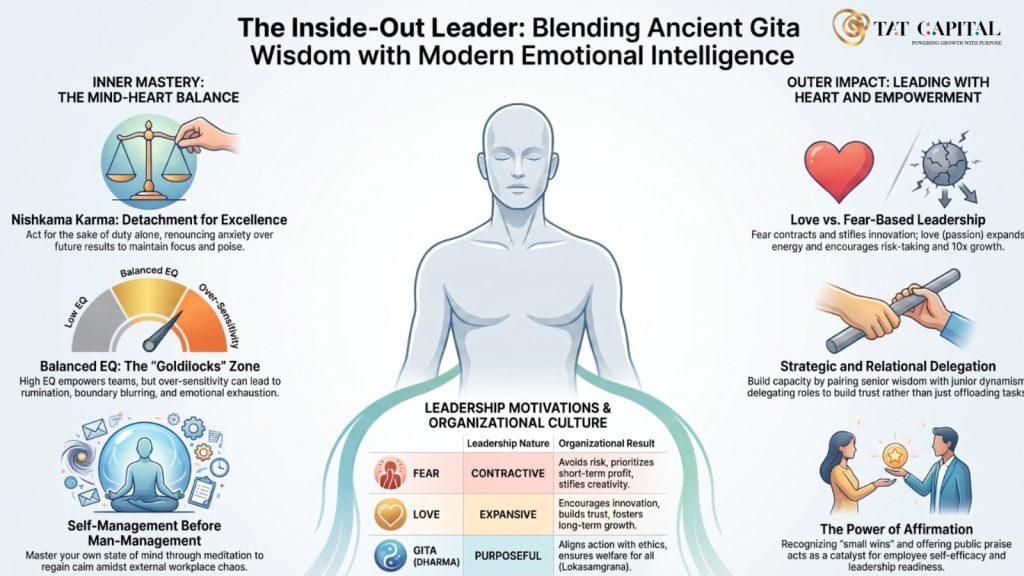
But the mind alone builds a brittle company. What makes it durable is emotional intelligence — the capacity to turn a job into a calling, to build the trust that makes people actually want to stay when things get hard. That’s the heart.
Logic gives your strategy its skeleton. EQ is the pulse that makes it viable.
2. Lead yourself before you lead the company
Fundraising, cofounder tension, market swings, the sheer loneliness of the seat — an unmanaged founder cannot provide the stability their company needs.
I call it the founder’s version of an old story: one more raise, one more valuation milestone, one more headline — and none of it fills the void, because the craving was never really about the number. It just relocates.
The fix isn’t indifference to outcomes. It’s giving 100% to the work and holding the result loosely, instead of building your self-worth on top of it.
3. Your culture is a mirror of you
Every team eventually reflects the founder’s internal state, at scale.
Fear-based leadership gets short-term output — and quietly breeds mistrust the moment you’re not watching. Love-based leadership treats people as capable of more, not less, and that’s what actually unlocks the courage for 10x thinking instead of incremental, fear-protected gains.
4. High EQ has a ceiling too
This one surprises people. Over-invested empathy can be just as damaging as none at all — excusing underperformance, avoiding hard conversations, diluting your own authority to stay liked.
The goal isn’t to be the “nice” founder. It’s nurturing and demanding. Compassion and conviction.
5. The real ROI
This isn’t soft stuff. High-EQ individuals consistently earn more, show up disproportionately among top performers, and EQ development is now core to leadership programs at the world’s largest companies. Emotional intelligence is a competitive advantage with a measurable return — not a nice-to-have you get to once the “real” work is done.
The bigger point
Founders are, in a real sense, missionaries — the ones who take a private conviction and turn it into a shared, working reality. It’s a lonely, high-variance job, and it’s produced a lot of cynicism lately about what building a company is even for.
I don’t think the answer is a better pitch deck.
I think it’s founders who bring the same rigour to their own inner state that they bring to their cap table — and who measure their legacy not in a quarterly slide, but in the welfare they created for everyone the company touched.
That’s what makes a company self-sustaining instead of just successful. And it’s how, one company at a time, we restore the faith that building something can still be an act of love — not just extraction.
Your right is to the work, not to the reward. Master the work with single-minded devotion and a calm mind — the reward will take care of itself.