
Beyond New Delhi: What Modi’s 2026 Visit Really Means for Australian Business?
The Australia-India relationship just got a lot more interesting — and a lot more local.
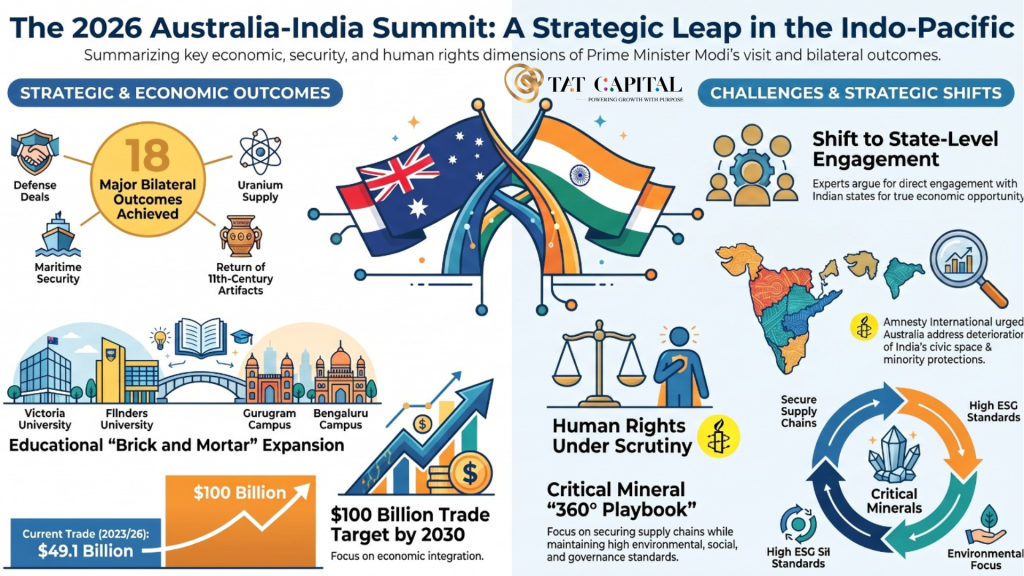
Prime Minister Modi’s July 2026 visit to Australia wasn’t just another diplomatic photo-op. It delivered 18 concrete outcomes across defence, energy, and technology — and quietly reset the playbook for how Australian companies should be approaching India.
Here’s the short version: the era of “India strategy = New Delhi strategy” is over.
🤝 What actually got signed
Defence & maritime security — a renewed Joint Declaration on Defense and Security Cooperation (JDDSC) and a new Maritime Security Collaboration Roadmap, deepening interoperability across the Indo-Pacific
Energy — administrative arrangements for the Civil Nuclear Agreement are finalised, clearing the way for direct uranium supply to India
Education — Flinders University (Bengaluru) and Victoria University (Gurugram) approved to open campuses on the ground
Culture — the repatriation of three 11th–12th century Indian antiquities, including the sacred bull Nandi — a small gesture doing a lot of trust-building work
🗺️ The real strategic shift: think states, not “India”
India isn’t one market. It’s a continental-scale economy where the states — not the centre — hold the real levers: land, labour regulation, environmental clearances, industrial incentives.
The smart money is already mapping Australian capability to specific state opportunity:
- Maharashtra & Gujarat → advanced manufacturing and clean energy
- Karnataka & Telangana → technology and Global Capability Centres
- Gujarat, Telangana & Tamil Nadu → critical minerals processing and financing corridors
- Boards still running a “Delhi-first” strategy are already behind.
⛏️ Critical minerals: the shield, the engine, the compass
Australia’s resource base and India’s manufacturing ambition are a near-perfect match — and both countries are treating minerals as strategic infrastructure, not just trade. Three things are converging:
Security — hedging against supply-chain coercion via the Minerals Security Partnership and Quad Investors Network
Economics — de-risking private capital through Export Finance Australia and India’s EXIM Bank
Sustainability — Australia’s ESG standards as a genuine commercial differentiator, not a compliance tax
⚖️ The part boards can’t skip
None of this works without a social license. Rights groups have flagged real concerns around civic space, minority protections, and the use of anti-terror legislation in India — and any Australian firm entering at the state level needs a clear-eyed view of local partners, land acquisition, and community impact. Treating ESG as a genuine differentiator, not window dressing, is now a competitive advantage.
✅ Five moves for leadership teams right now
- Build direct relationships with state industry bodies — don’t wait for New Delhi
- Use the diaspora as strategic intelligence, not just a talent pool
- Treat ESG as a moat, not a checkbox
- Get comfortable with Export Finance Australia and EXIM Bank as de-risking tools
- Plug into the federal working group on India to stay ahead of the next diplomatic move
The bottom line: the diplomatic scaffolding is now in place. The opportunity is real, the trade target ($100B by 2030) is ambitious, and the firms that win will be the ones operating at the state level — with a genuine, not performative, commitment to doing it right.
What’s your read — is your India strategy still Delhi-first, or has it already gone state-level?