
Equity Compensation: Navigating the Australian Regulatory Landscape
Equity compensation has moved from being a niche executive reward to a central strategic tool for Australian businesses. For startups, scale-ups, and mature private companies alike, the right equity structure can help attract talent, preserve cash, strengthen retention, and align employees with long-term business value.
In Australia, the regulatory landscape for employee equity has become more flexible in recent years, but it remains detailed and technical. Choosing the right structure is not just a legal or tax decision — it is a strategic one that can shape culture, cap table management, and exit readiness.
Why equity matters
At its core, equity compensation bridges the interests of employees and shareholders. When employees hold an ownership stake, they are more likely to think and act like long-term partners in the business.
This creates several practical advantages:
- It helps smaller companies compete for talent without matching large-corporate cash salaries.
- It encourages a stronger ownership mindset across the team.
- It preserves cash during periods of growth.
- It can support succession planning in private businesses.
- It improves investor confidence by demonstrating cap table discipline.
For many businesses, equity is not simply a reward mechanism. It is part of the operating model.
The main equity instruments
Australian companies typically use several different equity instruments, each with its own commercial and tax profile. The right choice depends on the company’s stage, funding position, and long-term objectives.
Options
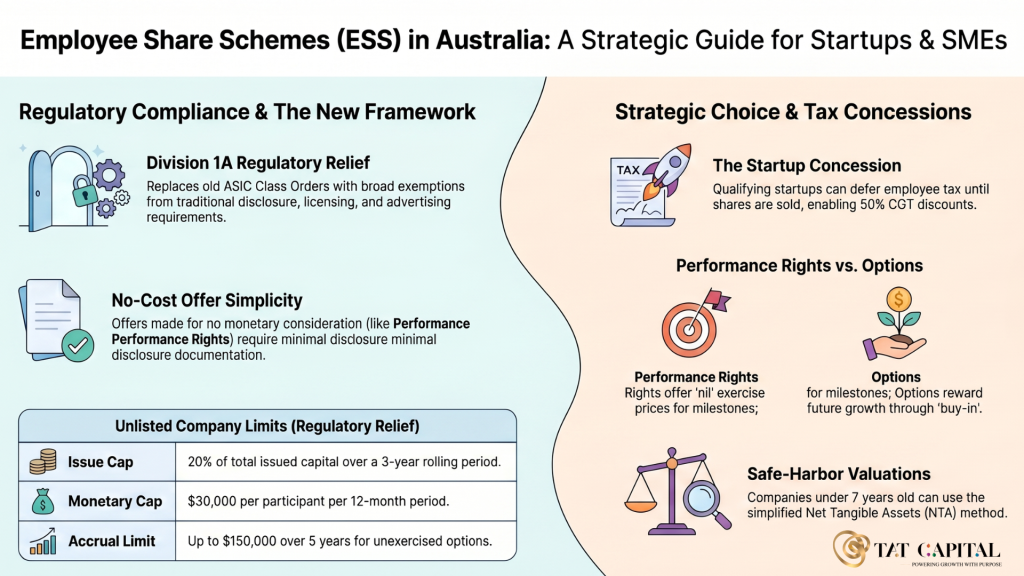
Options give employees the right to buy shares in the future at a fixed exercise price. They are often well suited to early-stage businesses because they create a strong growth incentive: employees only benefit if the company’s value increases.
Options can be powerful, but they also require employees to fund the exercise price later. If the company’s value does not rise sufficiently, the options may have little or no value.
Performance rights
Performance rights give employees the right to receive shares once certain time or performance conditions are met, usually without an exercise price. They are often used when the business wants to reward retention and milestone achievement rather than require an upfront buy-in.
Because employees do not need to pay to exercise them, performance rights are generally easier to understand and more accessible for recipients.
Restricted shares
Restricted shares are issued upfront but remain subject to vesting or transfer restrictions. They can be attractive in very early-stage businesses where founders want to create immediate ownership alignment.
However, they can also create tax complexity if the structure is not carefully designed, particularly where the employee receives an interest before having liquidity to cover any tax liability.
Zero exercise price options
Zero exercise price options sit somewhere between options and performance rights. They are legally structured as options, but the exercise price is nil.
These are often used where the company wants option-style documentation but performance-rights-style economics, especially when trying to access favourable tax outcomes under the start-up concession.
Loan-funded share plans
Loan-funded share plans involve the company advancing a limited-recourse loan to help employees purchase shares at market value. This can provide immediate ownership rights while reducing downside risk for employees.
These plans can be effective in mature private businesses, but they need careful structuring because of tax, accounting, and corporate law considerations.
Phantom share schemes
Phantom share schemes do not issue actual shares. Instead, they provide a contractual cash payment linked to the value growth of the business.
This can be useful where founders want to reward employees without diluting equity or complicating the cap table. Phantom schemes are often appealing for businesses that do not expect a near-term sale or listing.
Matching structure to business stage
The best equity design depends heavily on where the business is in its growth journey. A structure that works for a pre-seed startup may be the wrong fit for a profitable private company or a business preparing for exit.
Early-stage startup
For early-stage companies, the priority is usually attracting foundational talent while preserving cash. Options or restricted shares may be the most suitable structures, particularly where the company can access the Australian start-up concession.
At this stage, simplicity and upside potential matter most. The plan should reward belief in the business while keeping administration manageable.
Scaling business
As a company grows, senior talent becomes harder to retain and the equity plan often needs to support long-term performance. Performance rights or zero exercise price options may be better suited here.
These structures can provide meaningful retention value without requiring employees to make large out-of-pocket payments to participate.
Mature private company
Mature private businesses often prioritise loyalty, succession, and internal alignment rather than rapid value accretion. Phantom share schemes or loan-funded share plans can be particularly effective in this environment.
These structures allow leaders to share upside with employees while avoiding unnecessary dilution or cap table complexity.
Preparing for exit
When a company is approaching an IPO or trade sale, equity design becomes even more important. The plan should support retention through the transaction process and ensure employees are not exposed to unnecessary tax friction.
This is where vesting mechanics, taxing points, and liquidity planning need especially close attention.
Australian regulatory framework
The Australian employee share scheme landscape changed significantly with the 2022 reforms to the Corporations Act. These changes reduced some of the administrative friction that previously made equity plans harder to implement.
A key distinction now exists between offers made for no monetary consideration and offers requiring monetary consideration. That difference affects disclosure obligations, issue caps, and compliance requirements.
For many businesses, the practical takeaway is clear: the regulatory burden depends not only on whether equity is being offered, but also on how it is being offered.
Tax and compliance considerations
Tax treatment is one of the most important factors in equity design. The structure must be commercially attractive to employees while also remaining compliant and defensible.
For early-stage businesses, the start-up concession can be especially valuable because it may defer tax and shift the outcome into the capital gains framework. For later-stage businesses, tax-deferred schemes often become more relevant, particularly where performance hurdles or service conditions create a real risk of forfeiture.
Companies also need to think about valuations, reporting deadlines, and plan administration. A well-designed equity plan should be supported by clear documents, reliable valuation methodology, and disciplined annual reporting.
Strategic design principles
A good equity plan should do more than distribute upside. It should support the company’s broader strategy.
When designing a plan, leadership teams should consider:
- What is the main objective: attraction, retention, succession, or exit alignment?
- What stage is the business at today?
- How much dilution is acceptable?
- What level of cash outlay can employees realistically bear?
- How complex can the company’s compliance obligations be?
- What tax outcome is likely to be most efficient?
The answers to these questions will usually point toward one or two structures rather than a one-size-fits-all solution.
Final thought
Equity compensation works best when it is treated as a strategic instrument rather than a generic perk. In the Australian market, the right structure can help businesses attract talent, preserve capital, build loyalty, and prepare for future growth events.
The most effective plans are not only compliant — they are aligned with the company’s stage, goals, and ownership philosophy. For founders and leadership teams, that alignment is what turns equity from a legal document into a genuine growth lever.