
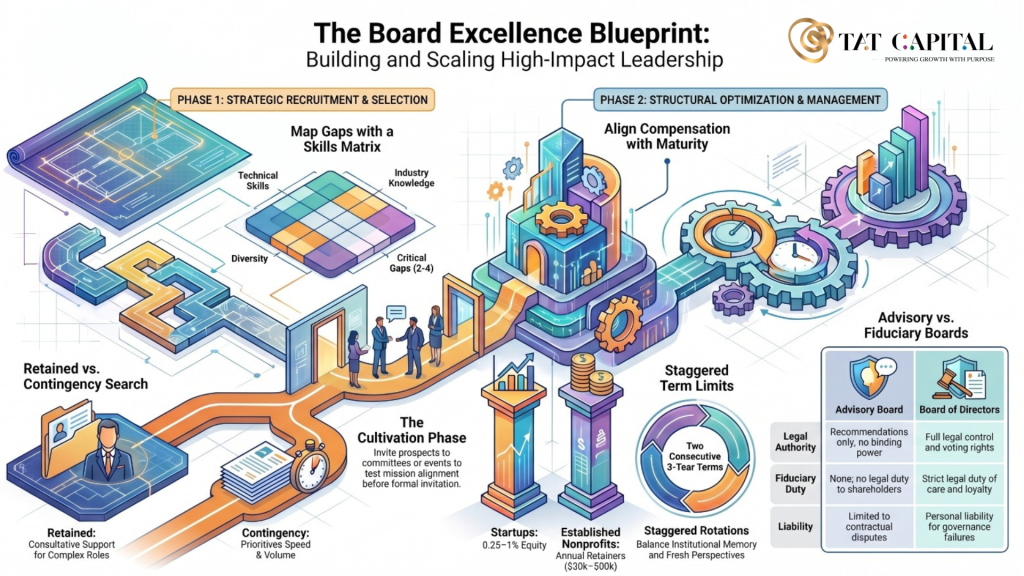
Architecting the High-Performance Board
Building a board that is designed, not assembled.
Most boards are built reactively. High-performance boards are architected intentionally.
A board should not simply fill seats. It should be designed as a strategic asset — one that helps the organization think ahead, challenge assumptions, and make better decisions.
Here are the core principles that separate an effective board from a merely functional one:
1. Start with strategy
Before recruiting anyone, map the company’s future needs against the current board’s capabilities. A board skills matrix is one of the simplest ways to identify gaps in experience, perspective, and expertise.
Look beyond financial and legal knowledge. The most resilient boards often include skills in:
- Cybersecurity.
- Digital transformation.
- ESG.
- Human resources.
- Industry-specific insight.
Diversity matters too. Not just demographic diversity, but diversity of background, experience, and thinking style. That is what reduces groupthink and improves decision-making.
2. Recruit for governance, not just credentials
The best board members are not always the most obvious ones.
A strong recruitment process should look beyond traditional CEO networks and consider functional leaders such as CIOs, CHROs, and General Counsel, as well as first-time directors with strong operational judgment.
In interviews, assess more than experience. Evaluate how candidates:
- Handle ambiguity.
- Listen under pressure.
- Challenge assumptions respectfully.
- Balance independence with collaboration.
The goal is not to find people who agree with management. It is to find people who can strengthen it.
3. Invest in onboarding and learning
Even great directors need context.
A new board member should be immersed in the company’s strategy, risks, operating model, and culture. Onboarding should not be a one-off event. It should be an ongoing process that helps directors contribute meaningfully, faster.
Board education should also continue over time. Regulatory change, market shifts, and new technologies all demand constant learning.
4. Rebalance board meetings toward strategy
Too many board meetings spend most of their time reviewing the past.
A high-performance board uses pre-read materials to shift the meeting itself toward discussion, judgment, and forward-looking decisions. A practical rule is to limit historical review to about 30% of the meeting and reserve the rest for strategy and debate.
The best boards ask questions like:
- What assumptions are we making?
- Where could this strategy fail?
- What would change our mind?
That is where board value is created.
5. Make evaluation and renewal normal
Strong boards do not avoid accountability.
Annual evaluations of the board, committees, and individual directors help identify weak spots, improve dynamics, and support growth. Term limits can also help keep the board fresh without creating unnecessary disruption.
Continuity matters. So does renewal. The best governance systems are built to balance both.
Advisory board or formal board?
For earlier-stage companies, an advisory board can be a smart fit when the goal is to get strategic support without full fiduciary complexity.
It works best when:
- The business is in early growth.
- The company is founder- or angel-funded.
- There are specific capability gaps.
- The founder wants advice without giving up control.
A well-structured advisory board is usually small, practical, and focused on the company’s next 18 to 36 months of growth.
A formal board, by contrast, becomes essential when institutional capital, governance rigor, and fiduciary oversight come into play.
Final thought
A great board is not defined by who sits in the room. It is defined by how intentionally the room was designed.
The highest-performing boards are built with strategy, diversity, accountability, and continuous renewal in mind.
That is what turns governance from a compliance exercise into a real competitive advantage.