

For many small and medium-sized enterprises, international trade looks attractive on paper and painful in practice. The sale is won, the goods are shipped, and the revenue is booked, but the cash often arrives later, in a different currency, after fees, spreads, delays, and operational friction have already reduced the margin.
That is why the real challenge in cross-border trade is not just growth. It is control.
The hidden economics of global trade
When SMEs expand internationally, they usually focus on the visible costs: freight, customs, insurance, and financing. But the more damaging costs are often less visible. Foreign exchange markups, intermediary bank deductions, delayed settlements, and compliance friction can quietly erode profitability on every transaction.
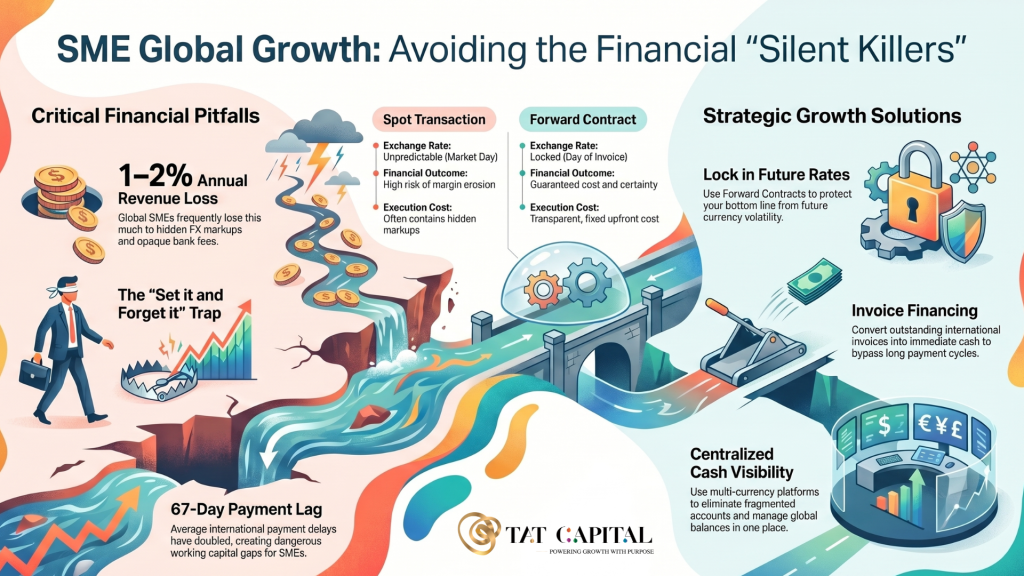
A business may think it is earning 10% to 12% on a deal, only to discover that 2% to 4% has disappeared through exchange-rate spreads alone. Add payment delays and extra working capital requirements, and the economics of the transaction can change materially.
This is why global trade should be viewed not only as a sales strategy, but as a working capital strategy.
Why margin leakage matters
The most dangerous form of cost in international trade is the one that does not show up clearly on an invoice. Hidden FX margins, slow cross-border payments, and manual reconciliation processes all create what can be described as an invisible margin drain.
That drain affects businesses in three ways.
First, it reduces gross profit by increasing the effective cost of conversion. Second, it creates uncertainty by exposing revenue to currency volatility between invoicing and settlement. Third, it locks cash inside the operating cycle, forcing the business to fund growth before customer payments arrive.
For SMEs, that combination can be punishing. A company can be profitable and still run short of cash simply because the timing of inflows and outflows is out of sync.
Currency risk is a business risk
Too often, FX risk is treated as a treasury problem. In reality, it is a commercial risk, a pricing risk, and a cash flow risk.
If a business invoices in one currency and pays suppliers in another, it is exposed to movements in exchange rates every day. Even a modest currency swing can wipe out margin on a transaction that looked safe when the deal was signed.
The solution is not to predict currency markets. The solution is to manage exposure deliberately.
A practical approach starts with understanding where cash is earned, where it is spent, and how long it takes to move between those points. Once that visibility exists, the business can build a strategy around actual cash flows rather than guesswork.
Better tools for managing exposure
There are several straightforward tools that help SMEs reduce FX risk without taking on unnecessary complexity.
Forward contracts are useful when a business wants certainty. They allow the company to lock in an exchange rate for a future payment or receipt, protecting margin from adverse movement.
Currency options offer another layer of flexibility. They provide protection if the market moves unfavorably, while still allowing the business to benefit if the exchange rate moves in its favor.
Currency matching is often overlooked but highly effective. If a business receives income in a foreign currency and also has expenses in that same currency, it can reduce risk by holding those funds in a multi-currency account or borrowing in the same currency. This creates a natural hedge and reduces conversion costs.
The best strategy is usually not the most sophisticated one. It is the one that fits the rhythm of the business.
Cash flow is where trade is won or lost
International trade does not fail only because of bad pricing. It often fails because cash flow arrives too slowly.
Late payments, settlement delays, and long credit terms create a working capital drag that limits reinvestment. The business may need to pay suppliers, fund inventory, and manage payroll long before customers settle their invoices.
That is why cash flow forecasting is essential. A good forecast does more than list receipts and payments. It shows when a business will face funding pressure, where the gaps will occur, and which exposures need to be hedged or financed.
The businesses that manage trade well are usually not the ones with the highest sales. They are the ones that understand timing.
Working capital deserves active management
Working capital is often treated as a financial reporting metric. It should be treated as a management discipline.
Inventory should be monitored closely so cash is not trapped in excess stock. Supplier terms should be negotiated carefully so the business pays at the right time, not simply the earliest time. Receivables should be tracked actively so late payments are identified before they become a larger problem.
A useful measure here is the cash conversion cycle. It shows how long it takes for cash to move through inventory, receivables, and payables before returning to the business. When that cycle shortens, liquidity improves. When it stretches, the business is forced to finance growth more heavily.
In practice, better inventory discipline, stronger collections, and more thoughtful supplier terms can unlock far more value than many businesses realize.
Finance operations can create competitive advantage
One of the most overlooked opportunities in cross-border trade is operational efficiency. Businesses that rely on manual processes often spend too much time chasing missing payments, reconciling bank statements, and handling fragmented multi-currency accounts.
By contrast, businesses that use specialist payment platforms, automation tools, and integrated accounting systems gain visibility and speed. They can track payments in real time, reduce reconciliation errors, and lower transaction costs.
This is not just an operations improvement. It is a strategic advantage. The more efficient the payment process, the more predictable the cash cycle. The more predictable the cash cycle, the more confidently the business can grow.
Trade finance can support scale
For businesses that import goods or need to bridge payment timing gaps, trade finance remains an important tool.
Letters of credit can reduce counterparty risk and help secure supplier confidence. Banker’s acceptances and trust receipts can allow businesses to receive goods before full payment is made, easing pressure on cash flow. Invoice financing and supply chain finance can also help convert receivables into usable liquidity.
These tools are most effective when used as part of a broader working capital strategy, not as emergency funding after the fact.
The strategic takeaway
The most resilient SMEs in global trade are not simply the ones with the best products or the strongest sales teams. They are the ones that actively manage currency exposure, cash flow timing, and working capital efficiency.
That means treating FX risk as a core business issue, not an administrative one. It means measuring the true cost of cross-border trade, not just the visible cost. And it means building systems that protect margin before problems appear.
In international trade, growth is important. But profitable growth depends on control.