

Why India’s Quantum Valley Matters for Australian Businesses
India’s new Quantum Valley initiative in Amaravati is more than a regional technology project. It is a signal that the next phase of deep-tech growth in Asia will be shaped by partnerships, and Australian businesses are well placed to benefit.
Australia already has strong capabilities in quantum hardware, control software, sensing, cybersecurity, and research commercialisation. India, meanwhile, is building the policy support, infrastructure, and talent base to accelerate quantum adoption at scale. Together, these two ecosystems look highly complementary.
For Australian companies looking at India, that matters. It means the opportunity is not limited to selling into a new market. It also includes co-developing technology, building pilot projects, testing applications, and forming long-term commercial relationships inside an emerging deep-tech hub.
What Quantum Valley is trying to build
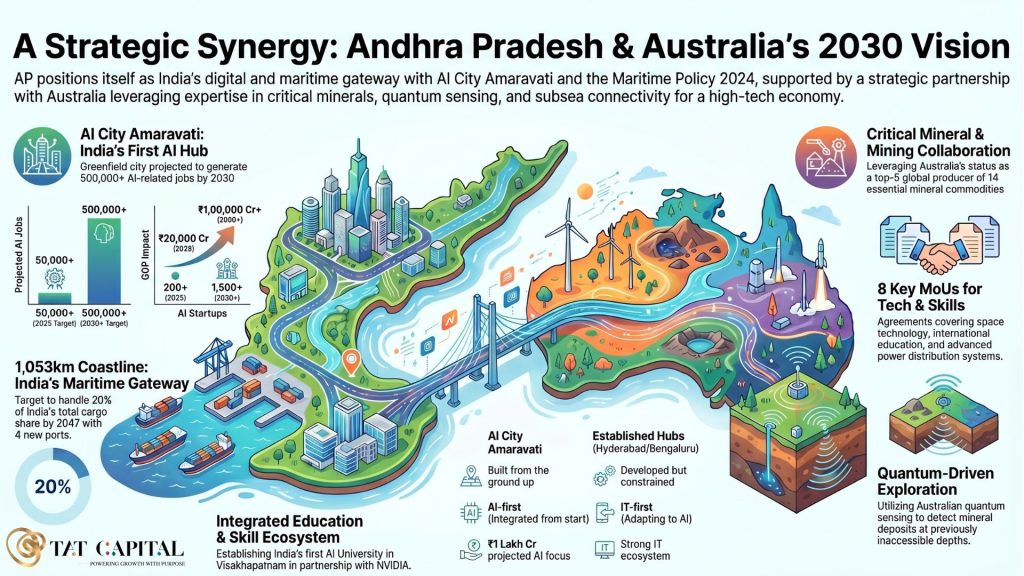
Amaravati Quantum Valley as part of a broader effort to position Andhra Pradesh as a global deep-tech destination. The initiative is anchored by the Andhra Pradesh Quantum Computing Policy 2025–30 and supported by facilities such as the Quantum Hardware Park, the Quantum Reference Facility, and QChipIN as a living-lab test environment.
That combination is important because quantum technology is not only about research breakthroughs. It also needs access to testing infrastructure, industrial partners, software tools, and skilled talent before it can become commercially useful.
In other words, Quantum Valley is designed to help move quantum innovation out of the lab and into practical deployment. That creates a natural opening for Australian firms with experience in building, validating, and commercialising advanced technology.
Where Australian firms fit
The strongest opportunity for Australia is in areas where it already has credible strengths and India has clear demand. These include silicon-based quantum hardware, quantum control systems, quantum-safe cybersecurity, sensing, and sector-specific applications in mining, agriculture, logistics, and connectivity.
Australian hardware companies can look at manufacturing or component supply into the Quantum Hardware Park. Australian software firms can contribute error correction, stabilisation, and control systems for quantum platforms. Australian research institutions can collaborate on proof-of-concept projects and joint development programs.
There is also a practical commercial angle for firms in resource and agritech sectors. Quantum sensing, satellite connectivity, and remote monitoring have obvious use cases in mining exploration, water management, and rural infrastructure, all of which are relevant to Andhra Pradesh’s economy.
Why the timing is attractive
One reason this opportunity stands out is that the ecosystem is being built now. That means Australian businesses do not need to wait for a mature market to emerge before engaging. Early entrants often have a better chance to shape standards, establish trust, and become preferred partners as infrastructure and procurement frameworks develop.
The document also points to incentive support that could reduce market entry friction. These include capital subsidies, land discounts, power reimbursements, tax support, and access to testing infrastructure for eligible firms operating within the state’s quantum ecosystem.
Just as importantly, the bilateral research pathway gives Australian organisations a structured way to enter the market. The Australia-India Strategic Research Fund is presented as a route for joint R&D in themes that include quantum computing and communications, as well as critical minerals processing.
The broader strategic value
This is not only a quantum story. It is also a story about how Australia and India can build a deeper innovation relationship. The Quantum Valley initiative creates a platform where universities, startups, corporates, and governments can work together on technologies that have both commercial and strategic importance.
For Australian businesses, that opens a broader India proposition. Instead of treating India as a single-market expansion opportunity, firms can think about it as a co-innovation base, a manufacturing partner, a testbed, and a talent source. That is a more ambitious model, but also a more durable one.
The biggest takeaway is simple: the companies that engage early will be best positioned to benefit. Whether the entry point is research, hardware, software, sensing, or workforce development, Quantum Valley offers Australian firms a way to participate in one of India’s most significant deep-tech buildouts.
Closing thought
India’s Quantum Valley is still early, but that is exactly why it matters. The foundations are being laid now, and Australian businesses with the right capabilities can help shape what this ecosystem becomes.
For firms thinking about India market entry, this is a timely reminder that the most valuable opportunities are often found where policy ambition, infrastructure investment, and technical capability align. Quantum Valley is one of those moments.
Disclaimer- Tat Capital provides this content solely for informational and knowledge-sharing purposes, based on publicly available data, research across multiple sources, and analytical inputs. While professional judgment, due care, and analysis supported by advanced tools have been applied, the information should be interpreted with discretion. Nothing herein constitutes financial or investment advice or a recommendation. Readers should not rely on this for capital market decisions and are advised to seek independent professional advice.