
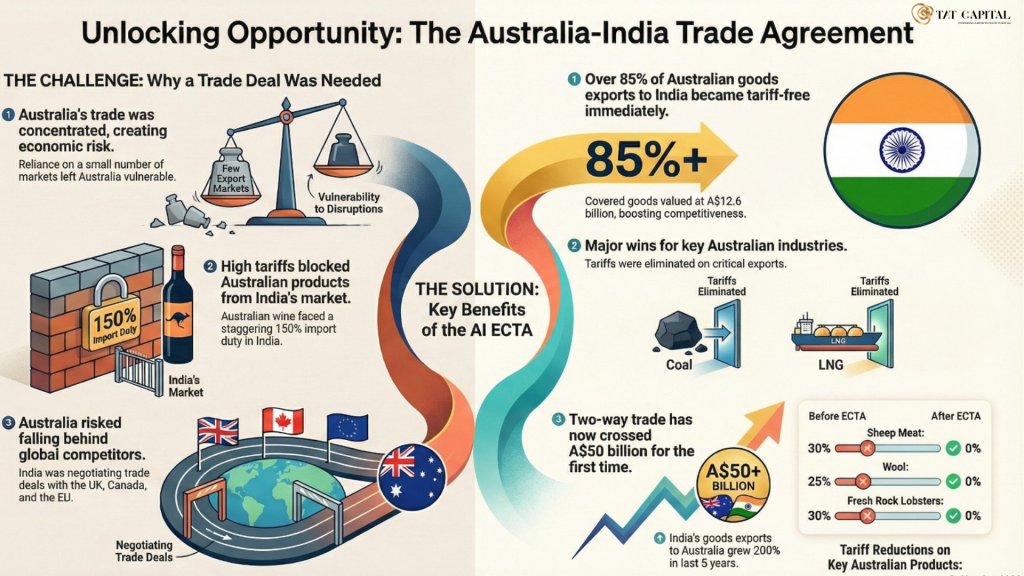
From 1 January 2026, Indian exports to Australia will enjoy 100% tariff elimination, marking a decisive shift from partial liberalisation to full market access. This milestone strengthens predictability, competitiveness, and resilience in a volatile global trade environment.
What changes materially:
Full Market Access & Competitive Edge
Zero duties across all tariff lines give Indian exporters a clear cost advantage over global peers—especially in textiles, leather, engineering goods, processed foods, and gems & jewellery (jewellery exports already up 16% Apr–Nov 2025). MSMEs benefit most, with lower landed costs improving margins and market entry.
Strategic Resilience & Diversification
Australia emerges as a stable, trusted export destination—offering Indian exporters a strong alternative to markets facing higher trade barriers, while reinforcing India’s Indo-Pacific economic integration.
Deeper Economic Complementarity
Australia supplies critical inputs (energy, minerals, rare earths) for India’s manufacturing and clean-energy push, while India strengthens its role as a supplier of manufactured and agricultural goods—supporting Make in India.
Pathway to CECA
ECTA’s success sets the stage for a broader CECA, expanding cooperation beyond goods into services, investment, technology, and digital trade.
Bottom line: Zero tariffs elevate India–Australia ties from a trade agreement to a strategic economic alliance focused on supply-chain security and shared growth.