
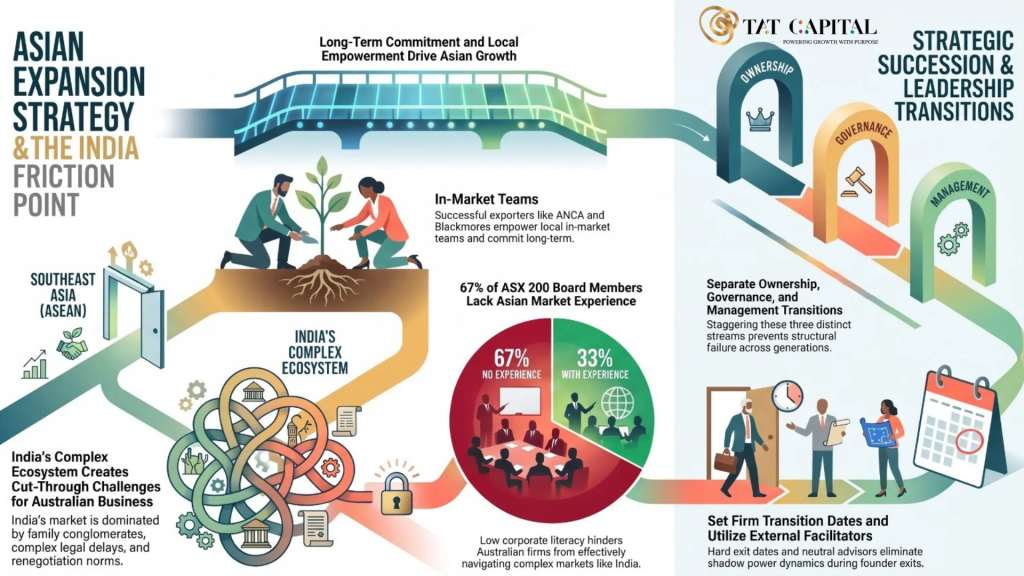
Australia’s largest private companies rarely give interviews, publish accounts or explain themselves. Yet a handful of them have built businesses that span a continent and, in some cases, a dozen countries. I pulled together four strategy papers on Asia expansion and added fresh research on the private champions behind the headlines. Three lessons stood out. So did one gap: India.
1. They win by going narrow, not wide
Linfox began in 1956 with one truck. Today it employs about 24,000 people in 11 countries. After the global financial crisis it cut its Australian customer base from more than 300 to 80, and revenue doubled over the next 11 years. Peter Fox calls it “less is more”.
Visy teaches the opposite lesson. Richard Pratt’s own rule was “don’t invest in companies you don’t understand”. A detour into insurance and heavy borrowing left the group, by one account, technically insolvent in the 1990 recession. A A$36m cartel fine followed years later.
Fewer, deeper customers. Control kept for the long term. Compliance treated as a growth asset, not a cost.
2. Succession is where the model breaks
Only 25% of Australian family businesses have a robust, documented and communicated succession plan, according to PwC. The big private names show three different outcomes.
- Linfox: divided the group between three sons in the 1990s and used professional CEOs. In June 2026, at 89, Lindsay Fox announced a new governance model with independent chairs, and eldest son Peter stepped back from his executive chair roles. Media reports say he was not warned.
- Visy: a scripted split after Richard Pratt’s death in 2009, with a named arbiter and separate assets for each child. Within months the managing director resigned and Anthony Pratt took over as executive chairman.
- Hancock: control without a process. Family trust litigation began in 2011, and a court appointed Bianca Rinehart trustee in 2015.
The common thread is simple. Write the roles down, appoint independent chairs before a crisis, name the arbiter and plan for the professional CEO to leave.
3. Asia rewards patience and structure
Linfox opened Shanghai in 1984, added Thailand and Malaysia in the 1990s, then India, Indonesia and Vietnam in the 2000s, and the Mekong countries in the 2010s. That is roughly one market a decade, with local leadership built along the way.
Most Australian boards are less ready. Asialink found in 2017 that 82% of the top 30 private companies were not adequately equipped for Asia. A separate survey cited in my source papers found that 56% of firms use no free trade agreement at all. They know the agreements exist. They do not claim the savings.
4. India: missing, not irrelevant
India barely appears in this conversation, and the reasons are instructive.
- The evidence base. Much of the survey data on Australian business in Asia covers Southeast Asia only.
- The money is not in operating companies. DFAT data shows A$22bn of Australian investment in India at the end of 2023, but only A$2bn of it is direct. Most arrives through funds, such as AustralianSuper’s A$3.3bn exposure.
- The barriers are different. Stretched state capacity, a state-by-state market, family-group partners who treat contracts as relationships, and a full trade agreement (the CECA) still unfinished.
The Australians who made India work took years and used local partners. Heat and Control, a Brisbane food-equipment maker, built a Chennai plant that now employs over 600 people and exports about 70% of its output. Acusensus spent about three years winning a road-safety contract in Tamil Nadu. Sharma’s Kitchen, a Sydney family dairy business, is building in Amritsar, with family roots and co-investors as its bridge.
Capital is crossing the corridor in both directions. The operating companies in the middle are the missing piece.
The other direction is moving faster. Indian companies completed 84 acquisitions in Australia between 2014 and 2026, worth about A$5.7bn, including Adani Ports’ A$3.9bn terminal purchase in 2025. My reading, not a finding in the sources: for founder-led Australian firms without a successor, an Indian buyer or partner could be a real option.
What growing companies should do now
Write the succession system before you need it. Constitution, independent chairs, a named arbiter, a founder exit date.
- Stay narrow. Go deeper with fewer customers.
- Add Asia-experienced independent directors and a CFO who can run multi-country finance.
- Audit trade agreements every year. Check rules of origin before paying standard tariffs.
- Enter one market at a time with local management and strict compliance. Australia’s new failure-to-prevent foreign bribery offence makes adequate procedures a legal defence.
- Treat India as a long game. Use a local partner, pick two or three states, make it a manufacturing and export base, and consider selling to Indian buyers first.
A caution: several company profiles rely on trade press and Wikipedia, the India success stories were chosen by promoters, and the DFAT fact sheet layout was hard to read. Check the numbers before you quote them.