
Two countries, one problem: how India and Australia keep family businesses alive
India writes hard rules. Australia builds capability. The smartest families borrow from both.
Most family businesses do not fail because the business fails.
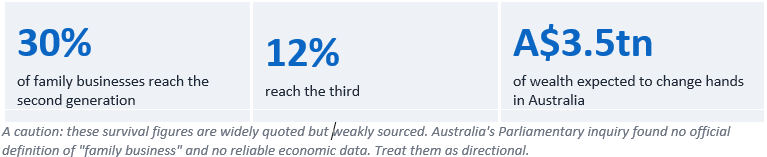
They fail because the family and the business were never separated. Roughly 30% reach the second generation and only about 12% reach the third.
The fix: two systems, not one
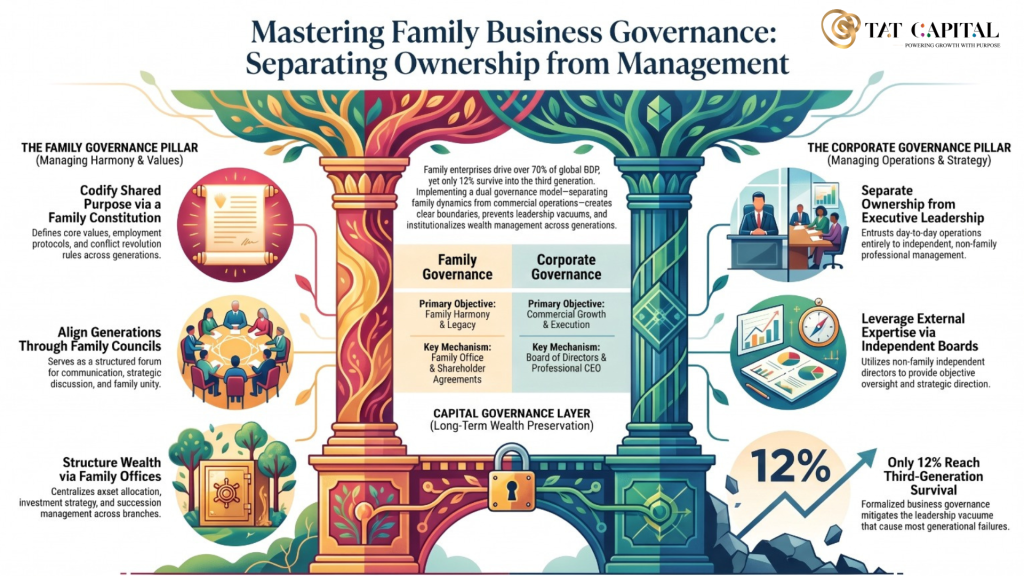
A family enterprise runs a family system (harmony, trust, legacy) and a business system (profit, risk, execution). Ordinary corporate governance only covers the second.
So the best families build a parallel structure on the family side:
- Family Assembly: everyone, once or twice a year
- Family Council: 5 to 9 elected members who set policy and settle disputes
- Family Constitution: the written rules on values, employment, share transfers and succession
- Family Office: professionals who run the wealth, outside the operating business
On the business side: a board of 5 to 9 with an independent majority and the CEO as the only executive.
India: write the rules down
Indian promoter families tend to be old, large and public, so they govern with firm rules.
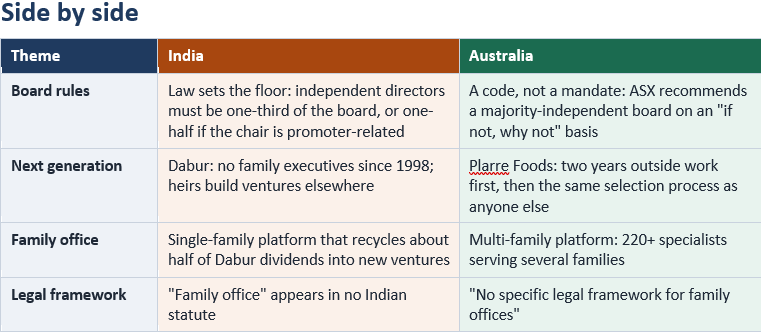
- Dabur (the Burman family) has barred family members from executive roles since 1998. No executive salary, no corporate office. Each branch gets one board seat, and father-son or sibling pairs may not sit together.
- Burman Family Holdings recycles about 50% of Dabur dividends into new consumer ventures, so ambitious heirs build businesses instead of competing for jobs.
- Godrej takes a different path: a hybrid where family members hold executive roles (8 of its 16 family council members), under non-family CEOs, six independent directors and a formal code of conduct.
- The law helps. Listed companies must have independent directors (one-third of the board, or one-half where the chair is promoter-related) plus audit, remuneration and risk committees.
Even good governance did not keep Godrej in one piece. In 2024 the group realigned into two branches. But it did so by contract, with a non-compete and shared brand, not by court.
Australia: build the capability
Australia has less prescription and more preparation. There is no inheritance tax, no dedicated family-office law, and a looser, “if not, why not” governance code. The pressure is succession: about A$3.5 trillion is expected to change hands, and 72% of family enterprises say succession planning is a challenge.
- Macadamias Australia set up a family council, constitution and policies in 2016, added an external chair and director in 2017, and later ran a major asset sale to PSP with that structure already in place.
- Plarre Foods, now in its fourth generation, makes family members work outside the business for at least two years, and puts CEO hopefuls through the same selection process as outsiders.
- Mutual Trust runs a multi-family office with 220+ specialists and, since 2024, a Rising Gen Leadership programme with Melbourne Business School: workshops, masterclasses, coaching and a peer network.
- Watch the details. Trust-tax rules, family-provision claims against wills and foreign-ownership screening all shape how families structure wealth.
Plarre’s chair warns of a “pretence of governance”: bodies on paper, no discipline in practice.
Five takeaways for cross-border families
1. Write the constitution before the dispute. Formal (Dabur) or principle-led (Godrej, Plarre), but written.
2. Mix India’s rules with Australia’s preparation. Hard limits where conflict risk is highest; education and coaching so heirs become capable owners.
3. Set your board standard at the stricter of the two regimes. Indian law fixes a floor; Australian practice is voluntary.
4. Plan for an orderly split. Branch separation can be a successful outcome if the agreements anticipate it.
5. One constitution, two compliance maps. Outbound Indian remittance limits and anti-avoidance rules sit beside Australian trust-tax and foreign-investment screening. Get advice early.