
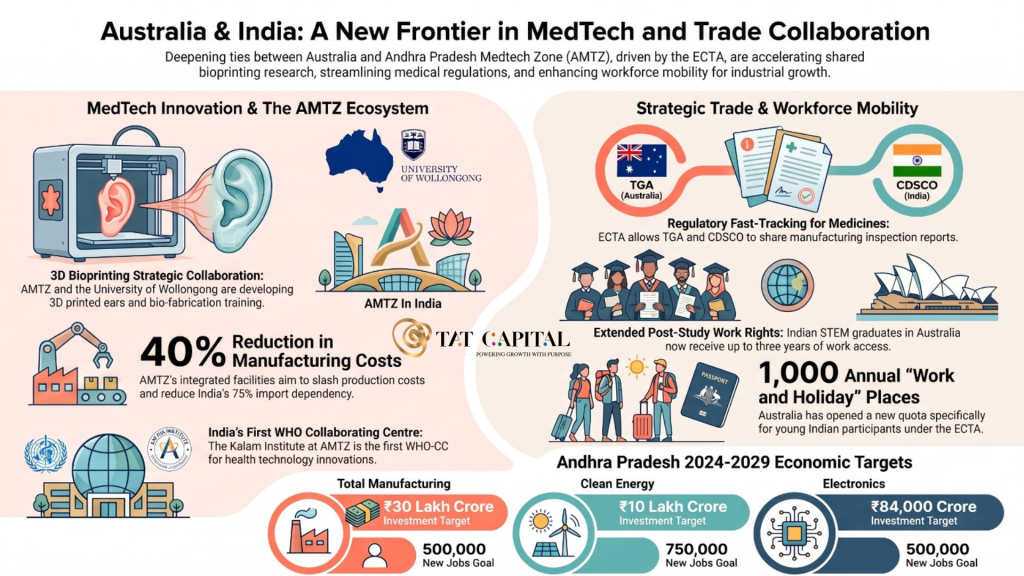
India has a 75% import dependency in medical devices. Australia has world-class MedTech IP and R&D. AMTZ (Andhra Pradesh MedTech Zone) and the ECTA trade agreement have just built the bridge between them — and the window to move early is now.
Why this matters right now
India’s medtech market can’t manufacture what it needs. Three out of every four devices are imported. That’s not a gap — it’s an open door for Australian innovators who can bring IP, R&D and regulatory rigour to a manufacturing partner that’s ready to scale.
Enter AMTZ, India’s first integrated medical device manufacturing zone in Visakhapatnam. Tim Thomas, CEO of the Centre for Australia-India Relations, calls it the “centre of gravity” for this partnership — and the numbers back him up:
• 100+ companies already operating inside a single co-located cluster
• ~40% lower manufacturing costs vs. building your own facility
• Built in 342 days — and proved its speed again during COVID, producing 100+ ventilators, 500 oxygen concentrators and 1 million RT-PCR kits daily
• Home to India’s first WHO Collaborating Centre for health tech innovation
The regulatory unlock
This isn’t just infrastructure — it’s backed by treaty. Under ECTA Annex 7A, Australia’s TGA and India’s CDSCO now recognise each other as “comparable regulators.” That means:
• TGA pre-market evaluations can be used directly by Indian regulators
• Shared GMP inspection reports cut down duplicate in-country inspections
• The relationship runs on regulator-to-regulator cooperation, not litigation — which means the real leverage is in the relationships you build early, not just the paperwork you file
Proof it works: 3D-printed ears
The University of Wollongong x AMTZ partnership (via UOW’s TRICEP program) is developing a scan-and-print package for 3D-printed prosthetic ears. The bigger story: it’s a template for a “software-as-a-medical-device” model — Australian firms keep the high-value IP, AMTZ handles the manufacturing and deployment at scale. Capital-light growth, not capital-heavy expansion.
The talent pipeline both ways
• Indian STEM graduates now get up to 4 years of post-study work rights in Australia
• Australia has opened 1,000 annual places in a new Work and Holiday stream for young Indians
• On the ground in Vizag, AMTZ’s Indian Biomedical Skill Council (IBSC) certification (built with Skill-Lync) is producing pre-trained biomedical engineers ready to plug into Australian-backed operations from day one
The state is backing this hard
Andhra Pradesh’s “4.0” policy framework (2024-2029) is targeting ₹30 lakh crore in investment and roughly 1.75 million new jobs — including ₹83,000 crore in FDI under the Industrial Development Policy 4.0 alone. The Ratan Tata Innovation Hub in Visakhapatnam is purpose-built to mentor and integrate international partners into this growth.
My take
I work at the intersection of Australian capital and India’s MedTech buildout — connecting Australian innovators and asset allocators into ecosystems like AMTZ. What stands out here isn’t any single number; it’s the alignment: a real market gap, a genuine cost advantage, a regulatory bridge that’s already built, and a state government actively courting foreign partners.
For Australian MedTech leaders, the playbook is simple:
1. Go CAPEX-light — use AMTZ’s shared facilities instead of building your own
2. Structure your TGA documentation to qualify under the comparable-regulator pathway
3. Anchor your entry in Visakhapatnam
4. Hire through IBSC for a workforce that already speaks the AMTZ system
The corridor is open. The question is who moves first.