
Australia has long been recognised for its strength in clinical research, regulatory quality, advanced medtech innovation, and institutional credibility. It is a market where healthcare companies tend to build high-value intellectual property, refine specialised technologies, and establish global standards. India, by contrast, is becoming one of the most important healthcare growth stories in the world, driven by scale, demographic momentum, digital adoption, manufacturing capacity, and a strong private investment ecosystem. Together, they create a powerful cross-border opportunity that spans the full healthcare value chain.
What makes this relationship especially interesting is that the two markets solve different problems for each other. Australia offers depth in early-stage innovation, clinical validation, and premium healthcare assets. India offers scale, affordability, engineering talent, manufacturing strength, and a fast-growing patient base. In practical terms, this means an Australian healthtech startup can use India to access cost-efficient talent, expand development capacity, and test products in a much larger market. At the same time, an Indian healthcare company can benefit from Australian institutional investors who bring long-term capital, governance discipline, and international market credibility.
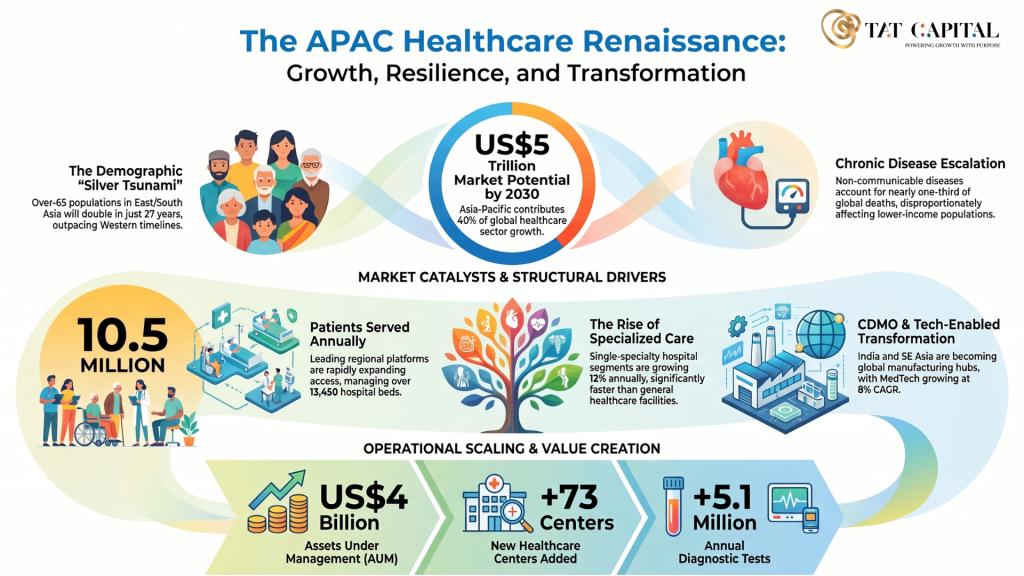
This complementarity is visible across several parts of the sector. In medtech, India is increasingly becoming a manufacturing and supply chain hub as global companies look to diversify away from China and localize production. In digital health, the pace of adoption across India is creating opportunities for platforms that can serve millions of users at scale. In specialty care, the rise of single-specialty hospitals and private healthcare platforms is attracting significant capital and accelerating sector consolidation. Australia remains strong in niche innovation, exportable healthcare technology, and premium healthcare services, but it is also facing a more selective funding environment, which makes cross-border partnerships even more relevant.
For investors, this creates a compelling thesis. Australia offers mature, high-quality healthcare assets with strong innovation credentials, while India offers faster growth, larger market potential, and more attractive expansion economics. For founders, the message is equally clear: building for a regional healthcare opportunity may be more effective than thinking only within domestic boundaries. The combination of Australian innovation and Indian scale can unlock stronger commercial outcomes, broader market access, and deeper strategic relevance.
In many ways, the Australia-India healthcare corridor is not just about capital flows or trade linkages. It is about building a more integrated ecosystem where ideas can be developed in one market, validated in another, scaled in a third, and financed across both. That is where the real opportunity lies.