
Your balance sheet isn’t your borrowing power
How lenders really size working capital, and the trade finance tools that change the answer
A business with $30 million of receivables and inventory on its balance sheet will not get a $30 million facility. In the textbook case it gets $20.5 million. The $9.5 million gap is the collateral haircut, and understanding it is the most useful thing a finance leader can do before approaching a lender.
I’ve recently pulled together four guides on working capital, trade finance and credit underwriting into one framework. Here’s what stood out.
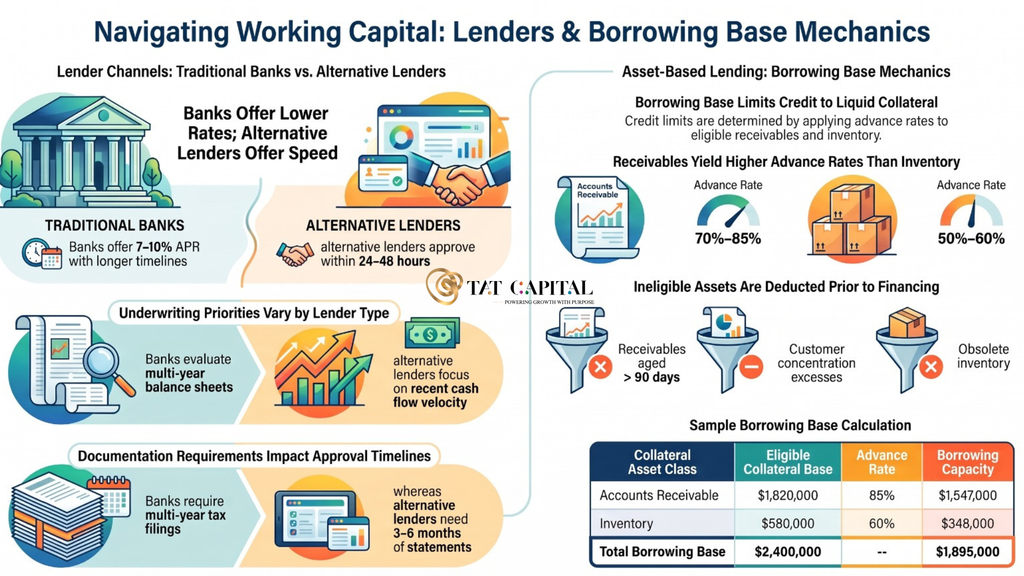
1. Lenders borrow against a “borrowing base”, not book value
The formula is simple:
(Eligible receivables × 75–85%) + (Eligible inventory × 50–60%)
The detail is in “eligible”:
- Invoices over 90 days are out entirely.
- If half of one customer’s balance is over 90 days, the whole customer is out.
- Any single customer above 2% of receivables gets reviewed, and concentration beyond the cap is carved out.
- Inventory is capped in dollars, however large the warehouse.
Clean up your collateral before the lender does. It is the cheapest way to raise your limit.
2. Speed costs money, and factor rates hide how much
Banks quote an APR (roughly 7–10%+) and take 2–8 weeks. Alternative lenders can fund in 1–3 days but quote a factor rate.
A $100,000 advance at 1.25 means $125,000 back over six months, by daily debit. That sounds like 25%. Because you repay daily, you hold about half the money on average, and the effective annual rate is closer to 90%. My own calculation on the daily schedule came to about 92%.
The test is simple: will the funds earn more than they cost?
3. Trade finance moves risk to someone better able to carry it
Lenders usually exclude foreign and concentrated receivables from the borrowing base. Two tools can bring them back:
- Letters of credit (UCP 600). A bank’s promise replaces the buyer’s. A confirmed credit also removes issuing-bank and country risk. The catch is that banks pay against documents, not goods. One mismatch can delay payment.
- Trade credit insurance. It shifts buyer default risk to an insurer, which can make invoices bankable. Under the Indian regulatory guidelines I reviewed, indemnity is capped at 85%, so the seller always keeps 15% of the risk. For Australia–India trade, check how local rules compare.
4. Underwriting is about control as much as credit
Beyond the numbers (a DSCR of at least 1.25x is the usual benchmark), lenders look for:
- personal guarantees from owners with 20%+ equity
- a regular borrowing base certificate
- control over where customer payments land (cash dominion)
A well-run facility means the lender can see the collateral and the cash.
Where to start
Before your next facility conversation:
- Match your urgency to your paperwork. Three years of financials point to a bank. Three months of bank statements point to an alternative lender.
- Strip out 90+ day invoices, apply caps and write down dead stock to see your real borrowing base.
- Compare the effective cost of debt with the return on the funds.